About 43 minutes
1914, and Other Poems — A Reader’s Guide
Adventure Picaresque Fiction
9,735 recorded words. 4 minutes difference from this book's estimate.
View Gutenberg source #33902
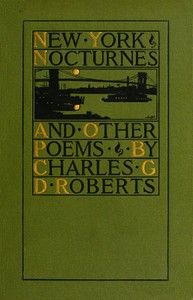
The source record for New York Nocturnes, and Other Poems — Context and Discussion measures this digital text at 8,793 words, 39 min estimated reading time, and 35 detected text sections.
The text analysis averages about 20.5 words per sentence, while the detected sections provide another way to judge how the source is divided.
Project Gutenberg metadata also associates the work with “Canadian poetry -- 19th century,” connecting these edition facts with the source record’s subject description.
Explore this collection
These alternatives are selected using recorded categories and estimated reading time.
About 43 minutes
Adventure Picaresque Fiction
9,735 recorded words. 4 minutes difference from this book's estimate.
View Gutenberg source #33902About 44 minutes
Adventure Picaresque Fiction
10,020 recorded words. 5 minutes difference from this book's estimate.
View Gutenberg source #30488About 50 minutes
Adventure Picaresque Fiction
11,349 recorded words. 11 minutes difference from this book's estimate.
View Gutenberg source #27370Search stored excerpts and compare books → Choose by your preferences →
Choices use stored catalog measurements. Estimates vary with reading speed. A shared category is a catalog label, not a claim that two books have the same argument or literary quality.
Search reads excerpt text stored with this catalog and links to its associated Gutenberg record. The connection is stored in the site database; this tool does not recheck that every excerpt is word-for-word identical to that external record. Excerpt search does not cover every chapter and does not verify historical publication dates.
Catalog snapshot checked: 2026-09-25. Coverage: 95 public books, 95 available source excerpts.
Read the complete public-domain text at its original source.
Read on Project GutenbergThe first poem, 'The Ideal,' immediately establishes the collection's central tension: a speaker 'faint with the city’s fume and stress' finds restoration through a woman's touch, which conjures 'moon-white woodland stillnesses' and 'childhood daisy fields.' This pattern—urban clamor yielding to remembered nature—recurs throughout the 'New York Nocturnes' section. In 'In the Crowd,' the crowd's 'eddying mirth and misery' contracts to the intimate 'I only hear thy low replies; I only see thine eyes.' The poems often hinge on such narrowing of focus, using the city's sensory overload as a foil for private, almost sacred encounters.
The volume's structure moves from these nocturnal cityscapes to a longer 'Other Poems' section that includes ballads, meditations, and nature lyrics. Readers will notice how Roberts carries the nocturne's mood—twilight, solitude, longing—into rural settings, testing whether the peace sought in 'The Ideal' can survive outside the city.
The opening poems depict New York as a place of 'fume and stress,' 'roar,' and 'eddying mirth and misery.' Yet the speaker rarely describes the city in detail; instead, it functions as a pressure that forces retreat inward. In 'Night in a Down-town Street,' the street is 'empty' and 'lorn,' while 'The Street Lamps' personifies the lamps as 'patient' and 'pale.' The city is a condition to be endured or transcended, not a place to be explored. This treatment aligns with the volume's epigraph from the Greek—'O Gods, what Aphrodite, or what desire, has joined this?'—suggesting that the urban setting is a crucible for love or longing.
Roberts' diction in these poems is deliberately restrained: 'pavements roar,' 'lights and cries,' 'the city’s weary miles.' He avoids the era's more sensational urban imagery, instead using the city as a blank backdrop against which interior dramas play out. This makes the sudden irruptions of natural imagery—'the wash of far, remembered waves'—all the more striking.
In 'The Ideal,' the speaker's memory supplies 'the moon-white woodland stillnesses' and 'one old garden’s lilac leaves.' This technique recurs: nature appears as a remembered or imagined counterweight to the city. 'My Garden' and 'Presence' continue this motif, with the garden becoming a site of spiritual renewal. The 'Nocturnes of the Honeysuckle' pair the flower's scent with a beloved's presence, blending sensory detail with emotional resonance.
But the later poems complicate this pastoral refuge. 'At Tide Water' returns to a marsh landscape, asking it to 'turn them in your measureless contemplation' the speaker's 'love, and the ashes of desire, and anguish.' The natural world here is not simply soothing but a force that demands mastery. 'The Falling Leaves' extends this to a cosmic scale: leaves and ages alike drift 'beyond recalling' under a divine breath. Nature, in these poems, offers perspective but not easy comfort.
The volume's ballads—'Marjory,' 'When the Clover Blooms Again'—introduce narrative and a more direct emotional register. 'Marjory' tells of a woman who leaves her rural home for 'the far-off city' and never returns. The refrain 'Marjory comes not here' echoes through stanzas that catalogue the farm's details: 'the gray barn-doors,' 'the milch cows,' 'the buttercup-golden hill.' The poem's power lies in its accumulation of specific, homely images that the absent Marjory once animated.
'When the Clover Blooms Again' offers a darker variation: a woman waits for her lover 'over sea,' but the poem reveals his body 'in a still, green-watered place.' The ballad form, with its repeated lines and simple diction, contrasts sharply with the nocturnes' more abstract lyricism. These poems suggest that the city's call can be fatal, and that rural life, for all its beauty, cannot guarantee return or reunion.
Roberts moves between tight lyric forms—quatrains, sonnets, ballads—and looser meditative verse. The 'New York Nocturnes' section favors short lines and regular rhyme, creating a contained, almost hypnotic rhythm. 'In the Crowd' uses couplets and repetition: 'The night is loud; the pavements roar. / Their eddying mirth and misery / Encircle thee and me.' The later poems experiment with longer lines, as in 'At Tide Water's' hexameters, and with more varied stanza patterns.
Several motifs recur across sections: hands ('cool white fingers,' 'light, light hand at the milking'), thresholds (windows, doors, the 'edge of the city'), and the act of listening ('I only hear thy low replies,' 'the dim whisper of the wheeling spheres'). These repeated elements create a cohesive texture, even as the settings shift from street to marsh to farm. Readers attentive to these threads will find the collection unified by more than its title.
Because the excerpts include only a portion of the 'Other Poems' section, the full range of Roberts' nature and meditative verse is not represented here. Readers should note that the ballads and lyrics after the nocturnes may further develop or challenge the urban-rural dynamic established in the opening. The collection rewards attention to its formal craft and to the way small, precise images—a lamp, a hand, a leaf—carry emotional weight across different contexts.
Roberts knew how city lamplight could blur a man’s memories, yet his ballads always found a firmer rhythm in the old country silence. I often set his book beside Poems of James McIntyre, where the same longing for simpler ground lingers in every cheerful line. Their kinship feels less like argument, more like two neighbours sharing one quiet evening’s bench. Poems of James McIntyre — A Reader’s Guide
Your answers remain private and are stored only in this browser.









