About 50 minutes
Oxford poetry, 1919 — Inside the Classic
Science Fiction Utopias
11,422 recorded words. 26 minutes difference from this book's estimate.
View Gutenberg source #50378
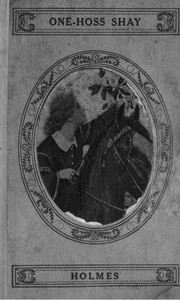
For The Wonderful "One-Hoss-Shay", and Other Poems — Context and Discussion, the stored edition analysis reports 5,344 words, 24 min estimated reading time, and 1 detected text section.
The text analysis averages about 23.8 words per sentence, while the detected sections provide another way to judge how the source is divided.
Project Gutenberg metadata also associates the work with “American poetry -- 19th century,” connecting these edition facts with the source record’s subject description.
Explore this collection
These alternatives are selected using recorded categories and estimated reading time.
About 50 minutes
Science Fiction Utopias
11,422 recorded words. 26 minutes difference from this book's estimate.
View Gutenberg source #50378About 58 minutes
Science Fiction Utopias
13,321 recorded words. 34 minutes difference from this book's estimate.
View Gutenberg source #36620About 61 minutes
Science Fiction Utopias
13,830 recorded words. 37 minutes difference from this book's estimate.
View Gutenberg source #36508Search stored excerpts and compare books → Choose by your preferences →
Choices use stored catalog measurements. Estimates vary with reading speed. A shared category is a catalog label, not a claim that two books have the same argument or literary quality.
Search reads excerpt text stored with this catalog and links to its associated Gutenberg record. The connection is stored in the site database; this tool does not recheck that every excerpt is word-for-word identical to that external record. Excerpt search does not cover every chapter and does not verify historical publication dates.
Catalog snapshot checked: 2026-09-25. Coverage: 95 public books, 95 available source excerpts.
Read the complete public-domain text at its original source.
Read on Project GutenbergThe title poem, “The Deacon’s Masterpiece: or the Wonderful ‘One-Hoss-Shay,’” is built around a single, extended conceit: a chaise constructed with such mathematical uniformity that it has no weakest point. Holmes dates the shay’s completion to the Lisbon earthquake of 1755, linking a man-made object to a natural cataclysm. The poem’s structure mirrors its subject—a logical chain of cause and effect that culminates in total, simultaneous disintegration. The other poems in this slim volume, “On Lending a Punchbowl” and “The Last Leaf,” offer contrasting moods: the former a convivial address to a bowl, the latter a meditation on age and survival.
The “One-Hoss-Shay” is presented as a “logical story,” and its logic governs both the chaise’s construction and the poem’s narrative arc. The deacon identifies the perennial flaw in any vehicle—a weakest spot—and resolves to eliminate it by making every part equally strong. Holmes enumerates the materials with almost comedic precision: oak for spokes and floor, lancewood for thills, ash for crossbars, white-wood for panels, and “Settler’s ellum” for hubs. The list reads like a builder’s ledger, each item chosen for its durability. The deacon’s dialect—“I dew vum” and “I tell yeou”—anchors the tale in a specific New England voice, while the poem’s anapestic meter drives the narrative forward with the inevitability of a clockwork mechanism.
Holmes sets the shay’s completion on the day of the Lisbon earthquake, a historical disaster that killed tens of thousands. This date is not incidental: it frames the chaise as a counterpoint to natural chaos. Where the earth opened and swallowed a city, the deacon’s creation stands as a triumph of human reason. Yet the poem’s climax—the shay’s sudden collapse after a hundred years—echoes the earthquake’s abrupt violence. The chaise does not wear out; it breaks down all at once, “like a bubble when it bursts.” The parallel suggests that even the most logical construction is subject to the same forces that level empires. The earthquake reference also grounds the poem in the 18th century, a period when Enlightenment faith in order was repeatedly tested by natural upheaval.
The deacon speaks in a thick New England vernacular that sets him apart from the poem’s narrator. His oath—“I dew vum”—and his reasoning about strength are rendered in phonetic spelling: “Thut the weakes' place mus' stan' the strain.” This dialect does more than add local color; it establishes the deacon as a practical philosopher, a man who trusts his own observations over received wisdom. The narrator, by contrast, uses standard English and addresses the reader directly (“Have you heard of the wonderful one-hoss-shay?”). This split in voice creates a tension between folk knowledge and literate storytelling. The deacon’s method—asking village folk where to find the strongest oak—is empirical, rooted in community lore. Holmes thus celebrates a kind of vernacular engineering that predates professional science.
Across the three poems, time is measured in different currencies. In the “One-Hoss-Shay,” a century is marked by the chaise’s endurance: “Colts grew horses, beards turned gray, / Deacon and deaconess dropped away.” The shay outlasts its maker. “The Last Leaf” takes a different view of longevity, focusing on a single withered leaf that clings to a bough through winter. The poem’s speaker observes an old man who is “like a leaf” in his isolation. “On Lending a Punchbowl” treats time more lightly, as the bowl accumulates stories with each use. Together, these poems form a triptych on material endurance: the chaise that fails all at once, the leaf that refuses to fall, and the bowl that passes from hand to hand. Holmes uses each object to ask how things—and people—hold together or fall apart.
Readers will find that the volume’s brevity rewards attention to its craft. The title poem’s logical structure invites rereading: trace how each material and measurement contributes to the final collapse. The shorter poems offer counterpoints in tone and theme, from the punchbowl’s sociability to the leaf’s solitude. Holmes’s use of dialect and historical reference roots these poems in a particular time and place, but their questions about durability and design remain open.
I found myself thinking of the one-hoss shay's perfect, sudden end—that whole century of wear arriving at once—and my mind drifted to the old ballads, where time likewise stands quietly still. The Book of Brave Old Ballads — Background and Themes holds that same patient, unhurried weight, things remembered less for their speed than for their lasting.
Answer a few questions and save a private reflection on this device.









