About 54 minutes
Religious Poems — Inside the Classic
Adventure Picaresque Fiction
12,401 recorded words. 4 minutes difference from this book's estimate.
View Gutenberg source #44778
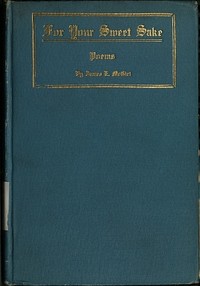
This digital edition of For Your Sweet Sake: Poems — Background and Themes is described by source-level measurements including 13,150 words, 58 min estimated reading time, and 3 detected text sections.
The text analysis averages about 23.3 words per sentence, while the detected sections provide another way to judge how the source is divided.
Project Gutenberg metadata also associates the work with “American poetry -- African American authors,” connecting these edition facts with the source record’s subject description.
Explore this collection
These alternatives are selected using recorded categories and estimated reading time.
About 54 minutes
Adventure Picaresque Fiction
12,401 recorded words. 4 minutes difference from this book's estimate.
View Gutenberg source #44778About 66 minutes
Adventure Picaresque Fiction
14,961 recorded words. 8 minutes difference from this book's estimate.
View Gutenberg source #596About 50 minutes
Adventure Picaresque Fiction
11,349 recorded words. 8 minutes difference from this book's estimate.
View Gutenberg source #27370Search stored excerpts and compare books → Choose by your preferences →
Choices use stored catalog measurements. Estimates vary with reading speed. A shared category is a catalog label, not a claim that two books have the same argument or literary quality.
Search reads excerpt text stored with this catalog and links to its associated Gutenberg record. The connection is stored in the site database; this tool does not recheck that every excerpt is word-for-word identical to that external record. Excerpt search does not cover every chapter and does not verify historical publication dates.
Catalog snapshot checked: 2026-09-25. Coverage: 95 public books, 95 available source excerpts.
Read the complete public-domain text at its original source.
Read on Project GutenbergJames E. McGirt's For Your Sweet Sake: Poems (1906) opens with a speaker who declares himself "born like the pines to sing," a metaphor that establishes the collection's central tension between natural impulse and artistic vocation. The volume's 52 poems range from dialect pieces like "Des Fo' Day" and "Signs o' Rain" to formal sonnets and narrative ballads, including the extended story "A Test of Love." McGirt, an African American poet, frequently shifts between standard English and vernacular speech, often within the same poem, as in "Signs of Death," where the speaker asserts his learning while embracing folk superstition. The catalog subjects classify this as American poetry by an African American author from the early twentieth century, but the excerpts reveal a more complex interplay of voices and forms than the subject headings alone suggest.
Several poems employ dialect to create a distinct persona, yet the speaker's relationship to that voice is often ironic or self-aware. In "Signs of Death," the speaker warns of omens like cows lowing and dogs howling, then directly addresses "learned people" who dismiss such beliefs: "I'm jus' er goin' 'o tell 'em dey're lyin'." The poem simultaneously performs folk wisdom and defends it against intellectual scorn. Similarly, "When De Sun Shines Hot" uses dialect to describe labor, but the speaker's closing claim—"I kno' I'm learned as high as anybody"—undercuts any simple reading of the dialect as uneducated. McGirt's dialect poems do not merely record folk speech; they stage a debate about the value of inherited knowledge versus formal education.
Across the collection, natural phenomena are repeatedly read as signs. "Signs o' Rain" catalogs weather portents, while "No Use in Signs" paradoxically dismisses such beliefs even as it enumerates them. The oak tree in "The Spirit of the Oak" stands as a symbol of endurance, "with head uplifted to the sky," weathering storms that drive away birds and eagles. In "A Mystery," the speaker cannot explain the ocean's song or why poppies grow among wheat, yet each natural detail "brings, my love, a thought of thee." This pattern of interpreting nature as a system of correspondences—whether romantic, spiritual, or superstitious—gives the poems a cohesive symbolic logic, even when the speaker professes ignorance.
The longest poem in the excerpts, "A Test of Love," shifts from lyric to narrative, telling a story set in the fictional land of Avia. The opening describes a pastoral scene with "board-roofed huts" along the Aztec shore, introducing characters Haggar, his daughter Alice, and the suitor Ed Lassiters. The poem recounts their childhood play—building houses from sticks and bark, baking mud cakes—and establishes Ed's devotion: "What e'er she willed it pleased Ed to obey." Though the excerpt breaks off before the promised test, the poem's existence suggests McGirt's ambition beyond the lyric mode. The setting, blending Aztec references with generic pastoral, indicates a deliberate exoticism that distinguishes this piece from the more personal poems in the collection.
Readers approaching For Your Sweet Sake will find a poet who moves fluidly between registers, using dialect not as a limitation but as a deliberate artistic choice. The catalog subjects accurately note the author's identity and era, but the poems themselves resist easy categorization. Pay attention to how McGirt frames knowledge—whether through the learned speaker of "Signs of Death" or the humble questioner of "A Mystery"—as this tension between certainty and doubt animates the collection.
There’s something about McGirt’s poems—how they carry both the weight of learning and the pull of older songs—that stayed with me long after closing the book. It reminded me of the quiet way The Land of Song, Book 2. For lower grammar grades — Story, Setting & Ideas holds its own gentle echoes, like hearing a familiar tune from another room. That feeling lingers, softly.
Build a private reading journal entry for this title.









