About 167 minutes
Poems of James McIntyre — A Reader’s Guide
Adventure Picaresque Fiction
38,204 recorded words. 2 minutes difference from this book's estimate.
View Gutenberg source #36068
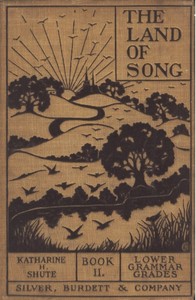
The Land of Song, Book 2. For lower grammar grades — Story, Setting & Ideas can be approached with a clearer sense of reading commitment from its source measurements: 38,855 words, 2 hr 49 min estimated reading time, and 11 detected text sections.
The text analysis averages about 21.6 words per sentence, while the detected sections provide another way to judge how the source is divided.
Project Gutenberg metadata also associates the work with “English poetry,” connecting these edition facts with the source record’s subject description.
Explore this collection
These alternatives are selected using recorded categories and estimated reading time.
About 167 minutes
Adventure Picaresque Fiction
38,204 recorded words. 2 minutes difference from this book's estimate.
View Gutenberg source #36068About 171 minutes
Adventure Picaresque Fiction
39,182 recorded words. 2 minutes difference from this book's estimate.
View Gutenberg source #37074About 149 minutes
Adventure Picaresque Fiction
34,261 recorded words. 20 minutes difference from this book's estimate.
View Gutenberg source #76332Search stored excerpts and compare books → Choose by your preferences →
Choices use stored catalog measurements. Estimates vary with reading speed. A shared category is a catalog label, not a claim that two books have the same argument or literary quality.
Search reads excerpt text stored with this catalog and links to its associated Gutenberg record. The connection is stored in the site database; this tool does not recheck that every excerpt is word-for-word identical to that external record. Excerpt search does not cover every chapter and does not verify historical publication dates.
Catalog snapshot checked: 2026-09-25. Coverage: 95 public books, 95 available source excerpts.
Read the complete public-domain text at its original source.
Read on Project GutenbergThe compilers of The Land of Song, Book 2 explicitly state in their preface that the volume aims to send children “into life with a genuine love for good reading.” To achieve this, they select poems that appeal to “the marvelous and the preternatural; in the natural world; and in human life, especially child life and the romantic and heroic aspects of mature life.” This editorial note examines how the compilers' choices in diction, dialogue, and description shape the reader's experience, using evidence from the included excerpts.
The ballad “King John and the Abbot of Canterbury” relies heavily on direct dialogue to drive its plot and reveal character. The king’s imperious commands—“Tell me to one penny what I am worth”—are met with the shepherd’s clever, measured replies. The shepherd’s speech is marked by a deferential yet witty tone: “For thirty pence our Savior was sold… And twenty-nine is the worth of thee.” This exchange not only advances the narrative but also establishes the shepherd as quick-witted and brave. The compilers’ inclusion of such dialogue-rich poems exposes young readers to character development through speech, a technique more common in prose fiction.
In contrast, William Wordsworth’s “To the Small Celandine” demonstrates a different authorial choice: meticulous description of a humble flower. The speaker notes the celandine’s “glossy breast” and its habit of appearing “Ere a leaf is on a bush, / In the time before the thrush / Has a thought about her nest.” Such specific temporal and visual details ground the poem in careful observation. The compilers’ selection of this poem, alongside the ballad, shows a deliberate variety in descriptive modes—from the broad strokes of narrative to the fine focus of lyric.
The two excerpts also differ sharply in structure. “King John” follows a clear narrative arc: a problem (the abbot’s impending execution), a solution (the shepherd’s impersonation), and a resolution (the king’s pardon). The poem’s stanzas are driven by question-and-answer exchanges, creating a rhythmic forward momentum. “To the Small Celandine,” by contrast, is meditative and circular, returning to the flower’s virtues across stanzas. The compilers’ juxtaposition of these structures within the same volume implicitly teaches readers that poetry can serve multiple purposes—storytelling and contemplation—each with its own formal demands.
The diction in the two poems occupies different registers. The ballad uses colloquial, even rustic language: “Nay, frown not,” “alack, I can neither write nor read.” The king’s exclamations—“swore by St. Bittel”—add a folkloric flavor. In contrast, Wordsworth’s poem employs a more elevated, reflective vocabulary: “Modest, yet withal an elf / Bold, and lavish of thyself.” The compilers’ inclusion of both registers exposes young readers to the range of poetic language, from the earthy to the lyrical, without privileging one over the other. This variety aligns with their stated goal of offering “literature of some scope.”
Readers approaching The Land of Song, Book 2 may find it rewarding to attend to how each poem constructs its world through specific verbal choices. The compilers have assembled a collection that rewards close reading of diction, dialogue, and structure, offering a foundation for literary appreciation that extends beyond mere enjoyment of story or sentiment.
That rainy afternoon, The Land of Song kept me company, its ballads and nature lyrics folding together like weather. I lingered on a sad Irish line, the diction so plain it ached, and found myself reaching for the shelf. There, another volume opened the same door: A Celtic Psaltery Being Mainly Renderings in English Verse from Irish & Welsh Poetry — Themes and Context. Same cadence, older bone. One book simply led home to the other.
Create a short personal record of your experience with this book.









