About 89 minutes
A-Naughty-Biography and other poems — Key Ideas to Explore
Adventure Picaresque Fiction
20,379 recorded words. 6 minutes difference from this book's estimate.
View Gutenberg source #60504
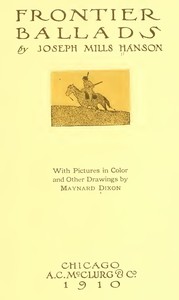
The catalog record for Frontier Ballads — Text and Context provides practical reading context through 18,944 words, 1 hr 23 min estimated reading time, and 5 detected text sections.
The text analysis averages about 28.3 words per sentence, while the detected sections provide another way to judge how the source is divided.
Project Gutenberg metadata also associates the work with “Folk songs, English -- West (U.S.),” connecting these edition facts with the source record’s subject description.
Explore this collection
These alternatives are selected using recorded categories and estimated reading time.
About 89 minutes
Adventure Picaresque Fiction
20,379 recorded words. 6 minutes difference from this book's estimate.
View Gutenberg source #60504About 68 minutes
Adventure Picaresque Fiction
15,501 recorded words. 15 minutes difference from this book's estimate.
View Gutenberg source #51992About 66 minutes
Adventure Picaresque Fiction
14,961 recorded words. 17 minutes difference from this book's estimate.
View Gutenberg source #596Search stored excerpts and compare books → Choose by your preferences →
Choices use stored catalog measurements. Estimates vary with reading speed. A shared category is a catalog label, not a claim that two books have the same argument or literary quality.
Search reads excerpt text stored with this catalog and links to its associated Gutenberg record. The connection is stored in the site database; this tool does not recheck that every excerpt is word-for-word identical to that external record. Excerpt search does not cover every chapter and does not verify historical publication dates.
Catalog snapshot checked: 2026-09-25. Coverage: 95 public books, 95 available source excerpts.
Read the complete public-domain text at its original source.
Read on Project GutenbergJoseph Mills Hanson's Frontier Ballads opens with a personal creed that sets the tone for the collection: the poet declares his allegiance to the "storm-brewed Western streams" and "prairie wind," favoring the "virile men of brain and brawn" over the "morbid skill of a critic's drill." This manifesto, written in a ballad meter, immediately establishes a tension between rugged individualism and the constraints of civilized society. The poems that follow are grouped into three thematic sections—Soldier Songs, Prairie Songs, and River Songs—each exploring different facets of frontier life. Hanson's voice is direct and unadorned, often employing colloquial speech and concrete imagery drawn from the natural world. The ballads are not merely nostalgic; they grapple with the moral complexities of expansion, as seen in poems like "The Ballad of Sergeant Ross" and "Jesus Garcia," where duty and sacrifice are tested against harsh realities.
The first section, Soldier Songs, presents military life on the plains through a lens of stoic endurance. In "Dakota Militia," the speaker describes a makeshift unit with a tone of wry pride: "We're the boys that fight the Injuns / When the regulars are away." The humor undercuts the danger, but the poem "The Ballad of Sergeant Ross" reveals a darker side, where a soldier's loyalty leads to a fatal confrontation. Hanson avoids glorifying violence; instead, he emphasizes the psychological weight of duty. "The Springfield Calibre Fifty" focuses on the rifle itself as a character, its "steady kick" a metaphor for the soldier's resilience. The language is spare, relying on rhythm and repetition to evoke the monotony and sudden terror of garrison life. A recurring motif is the contrast between the domestic and the martial—letters from home, Christmas celebrations—which heightens the sense of isolation.
The Prairie Songs shift to civilian life on the plains, where the landscape itself becomes a protagonist. "The Call of the Wind" personifies the prairie breeze as a seductive, restless force that pulls the speaker away from settled comforts. In "Cowboy Song," Hanson adopts a laconic, first-person voice: "I ride the range from sun to sun / And my work is never done." The poem "Christmas Eve at Kimball" juxtaposes holiday cheer with the starkness of a frontier town, where "the wind blows cold and the snow lies deep." A notable piece is "Jesus Garcia," a narrative ballad about a Mexican engineer who sacrifices himself to save a town from a burning freight car. The poem builds tension through detailed description of the desert setting and the train's arrival, then pivots to a moment of heroism. Garcia's choice is presented without sentimentality, underscoring the theme of selfless duty that runs through the collection.
The final section, River Songs, turns to the waterways that shaped frontier commerce and travel. "The Missouri" opens with a vivid portrait of the river as a "muddy giant" that "rolls its burden to the sea." Hanson captures the labor of steamboat crews and the dangers of navigation, using a rolling meter that mimics the river's flow. "Jake Dale" tells the story of a riverman whose life is defined by the Missouri's whims; the poem's refrain, "He's a man that knows the river," emphasizes expertise earned through hardship. In "The Engineer of the 'Golden Hind'," the focus shifts to a steamboat pilot whose skill is tested by a treacherous bend. The language is technical but accessible, with terms like "snag" and "sandbar" grounding the verse in practical knowledge. These poems celebrate the human ability to master nature while acknowledging its indifference, a tension that echoes throughout the collection.
Hanson's ballads are best approached as individual snapshots rather than a continuous narrative. Readers may notice how the poet's own creed—valuing "the strength of the living God," "a noble woman's love," and "his country's flag"—shapes the moral landscape of each piece. The illustrations by Maynard Dixon, though not reproduced here, complement the text's visual sensibility. For those interested in the intersection of popular verse and historical memory, Frontier Ballads offers a window into early twentieth-century attitudes toward the American West, filtered through a distinctly personal lens.
The rain kept time with Hanson’s prairie verses, and I lingered on the soldier songs—their quiet ache for home. That evening, scanning the shelf, my hand landed on 1914, and Other Poems — A Reader’s Guide. The same loneness seemed to breathe there, but darker, older. Something about duty and distance never really changes. I simply sat, turning pages, as the afternoon dimmed.
Answer a few questions and save a private reflection on this device.









