About 83 minutes
Frontier Ballads — Text and Context
Adventure Picaresque Fiction
18,944 recorded words. 6 minutes difference from this book's estimate.
View Gutenberg source #45240
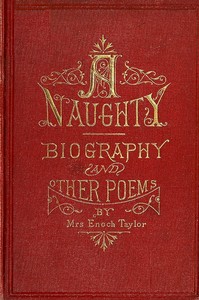
A-Naughty-Biography and other poems — Key Ideas to Explore can be approached with a clearer sense of reading commitment from its source measurements: 20,379 words, 1 hr 29 min estimated reading time, and 4 detected text sections.
The text analysis averages about 28.0 words per sentence, while the detected sections provide another way to judge how the source is divided.
Project Gutenberg metadata also associates the work with “American poetry -- 19th century,” connecting these edition facts with the source record’s subject description.
Explore this collection
These alternatives are selected using recorded categories and estimated reading time.
About 83 minutes
Adventure Picaresque Fiction
18,944 recorded words. 6 minutes difference from this book's estimate.
View Gutenberg source #45240About 100 minutes
Adventure Picaresque Fiction
22,859 recorded words. 11 minutes difference from this book's estimate.
View Gutenberg source #65592About 104 minutes
Adventure Picaresque Fiction
23,718 recorded words. 15 minutes difference from this book's estimate.
View Gutenberg source #20356Search stored excerpts and compare books → Choose by your preferences →
Choices use stored catalog measurements. Estimates vary with reading speed. A shared category is a catalog label, not a claim that two books have the same argument or literary quality.
Search reads excerpt text stored with this catalog and links to its associated Gutenberg record. The connection is stored in the site database; this tool does not recheck that every excerpt is word-for-word identical to that external record. Excerpt search does not cover every chapter and does not verify historical publication dates.
Catalog snapshot checked: 2026-09-25. Coverage: 95 public books, 95 available source excerpts.
Read the complete public-domain text at its original source.
Read on Project GutenbergMrs. Enoch Taylor's A-Naughty-Biography and other poems (1878) opens with a mock-autobiographical poem that recounts the speaker's infancy in jaunty, self-deprecating couplets. The voice is colloquial and wry: the newborn arrives "a-crying" to find "few preparations made" and a cradle of "painted pine" that "rocked so rough it made me whine." The poem's comic complaints—colic, teething, whooping cough—are delivered with a deadpan exaggeration that undercuts any sentimentality. This opening establishes a distinctive blend of domestic realism and playful self-mockery that carries through the collection.
The volume's second half shifts to miscellaneous lyrics on seasonal change, lost love, and social critique. Poems like "The Song of the Slush" and "Betrayed" reveal Taylor's range: the former uses a comic refrain to mock romanticized snow, while the latter adopts a grave, ballad-like tone to narrate a rustic girl's seduction and abandonment. Across the collection, Taylor's diction oscillates between homely specificity and conventional sentiment, often within a single poem.
The title poem, A-Naughty-Biography, is a four-part mock autobiography that traces the speaker from infancy to young adulthood. Taylor's comic strategy relies on anticlimax and domestic detail. The infant's "baby-spite" at finding a "plain" home is rendered in rhyming couplets that mimic a child's petulance: "If I had unexpected come, / And found this unpretending home, / I might the negligence excused, / But now I felt I was abused." The humor derives from the gap between the grand complaint and the trivial grievance—a cradle that rocks too roughly, pewter spoons that scratch.
Taylor extends this technique to school life and girlhood, where the speaker's mishaps are catalogued with the same mock-heroic gravity. The effect is less satirical than affectionate; the poem's tone suggests a wry fondness for past troubles. The diction remains deliberately plain—"one-horse farm," "colic," "whooping-cough"—anchoring the comedy in recognizable, unglamorous experience. This choice distinguishes the poem from more sentimental autobiographical verse of the period.
Several of the miscellaneous poems engage with seasonal imagery, but Taylor often subverts the expected pastoral or melancholic treatment. In "The Song of the Slush," the speaker complains about the muddy aftermath of snow: "The slush, the slush, the terrible slush, / That streams from each pore of the earth with a gush." The poem's refrain—"All on account of the 'Beautiful Snow'"—directly mocks the idealized snow of popular verse, grounding the lyric in the physical annoyance of wet feet and slippery pavements.
Similarly, "The Dark Days of Winter" begins with conventional pensive emotion—"The heart becomes tinged with pensive emotions / As Nature, in mourning, thus withers and dies"—but ends with a pragmatic acceptance: "We can't hope for springtime all thro' the year." Taylor's seasonal poems thus oscillate between borrowed sentiment and a more matter-of-fact resignation, revealing an authorial voice that is aware of poetic conventions but not entirely bound by them.
Taylor's longer narrative poems, such as "Betrayed" and "Found Drowned," adopt a grave, ballad-like meter to recount stories of seduction and abandonment. "Betrayed" introduces a "rustic beauty" whose "happy-hearted" innocence is exploited by a "gay and dashing lover" from the city. The poem traces her fall with a moralizing clarity: "He woos this simple-hearted girl, / He tells her of the city's whirl." The diction here is more conventional and less comic, relying on stock phrases like "pleasure's cup runs over" and "fairy dream."
Yet Taylor's treatment is not entirely formulaic. The betrayed woman's descent is described with a starkness that avoids melodrama: "Crushed beneath that heavy blow, / She sank in deep dejection." The poem's final stanzas emphasize social isolation—"Estranged each friendly face appears"—rather than physical ruin. This focus on reputation and community shame gives the ballad a specific social texture, rooted in the period's anxieties about female virtue.
Across the collection, Taylor's diction fluctuates between colloquial plainness and conventional poeticism, often within the same poem. In the title poem, phrases like "made me whine" and "nearly set my mother wild" sit alongside more elevated lines such as "Full forty years have passed and gone." This mixture creates a hybrid voice that is neither fully comic nor fully sentimental, but rather a vernacular persona that can shift registers quickly.
Taylor also uses dialectal or informal constructions—"a-crying," "I've heard them say," "one-horse farm"—that root the speaker in a specific rural or small-town milieu. These choices contrast with the more polished, abstract language of poems like "Love's Longings" or "Music," which employ conventional romantic imagery. The effect is a collection that feels uneven but also deliberately varied, as if Taylor is testing different poetic voices against each other. The vernacular passages are often the most memorable, suggesting where the author's strengths lie.
Readers approaching A-Naughty-Biography and other poems will find a collection that resists easy categorization. The title poem's comic autobiography is the most distinctive piece, but the shorter lyrics and ballads reveal a poet experimenting with tone and subject. Taylor's willingness to mix the homely with the sentimental, and to undercut poetic clichés with mundane detail, gives the volume a curious, uneven energy. Those interested in nineteenth-century women's verse, or in the intersection of humor and moral sentiment, will find much to examine in these pages.
That rainy afternoon, Mrs. Enoch Taylor’s playful rhymes about childhood mishaps made me smile, but the quiet betrayals beneath them lingered. I set it down, and my fingers drifted to an older, sterner volume on the shelf. Its thunderous warnings felt strangely comforting after all that gentle sorrow, like finding a steady hand in the dark. The Day of Doom; Or, A Poetical Description of the Great and Last Judgment With Other Poems — Story, Setting & Ideas waits there still, patient as a storm.
Your answers remain private and are stored only in this browser.









