About 104 minutes
Hero and Leander and Other Poems — Edition Insights
Adventure Picaresque Fiction
23,718 recorded words. 4 minutes difference from this book's estimate.
View Gutenberg source #20356
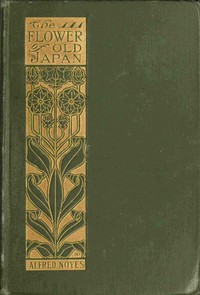
Before opening The Flower of Old Japan, and Other Poems — A Reader’s Guide, the edition data offers a quick orientation: 22,859 words, 1 hr 40 min estimated reading time, and 5 detected text sections.
The text analysis averages about 33.0 words per sentence, while the detected sections provide another way to judge how the source is divided.
Project Gutenberg metadata also associates the work with “English poetry -- 20th century,” connecting these edition facts with the source record’s subject description.
Explore this collection
These alternatives are selected using recorded categories and estimated reading time.
About 104 minutes
Adventure Picaresque Fiction
23,718 recorded words. 4 minutes difference from this book's estimate.
View Gutenberg source #20356About 89 minutes
Adventure Picaresque Fiction
20,379 recorded words. 11 minutes difference from this book's estimate.
View Gutenberg source #60504About 115 minutes
Adventure Picaresque Fiction
26,424 recorded words. 15 minutes difference from this book's estimate.
View Gutenberg source #58716Search stored excerpts and compare books → Choose by your preferences →
Choices use stored catalog measurements. Estimates vary with reading speed. A shared category is a catalog label, not a claim that two books have the same argument or literary quality.
Search reads excerpt text stored with this catalog and links to its associated Gutenberg record. The connection is stored in the site database; this tool does not recheck that every excerpt is word-for-word identical to that external record. Excerpt search does not cover every chapter and does not verify historical publication dates.
Catalog snapshot checked: 2026-09-25. Coverage: 95 public books, 95 available source excerpts.
Read the complete public-domain text at its original source.
Read on Project GutenbergAlfred Noyes opens his preface with a warning: poetry, like shot silk, glances with many colours, and to define its meanings is a mistake. The title poem, he insists, has no real relation to Japan—it is a dreamland an imaginative child might build from the oddities of a willow-pattern plate. Yet the poem was praised as a vivid picture of Japan, earning Noyes invitations to the Japan Society in London. This tension between fantasy and literal reading runs through the collection.
The excerpts show a poem thick with sensory contrast: 'Sweetness with the horror blent' in glades of rose and blue. A gryphon passes like a meteor; mammoths and woolly bears blink among valley-lilies. The verse shifts between childlike catalogues and a haunting refrain, 'Little Boy Blue, come blow up your horn,' which summons a darker note of weariness and longing.
Noyes explicitly distances his Japan from geography. The poem's landscape is built from the 'oddities of a willow-pattern plate'—a child's fantasy of pagodas, fairy moons, and 'hills of topaz, lakes of dew.' The preface recounts that a prosaic critic once wrote a lengthy review to point out Noyes's ignorance that Stevenson was buried in Samoa, not in this dream country. The poet's aim, he states, is not accuracy but the 'Kingdom of Dreams,' which he calls 'the only true, the only real, Kingdom.'
The verse itself reinforces this: glimpses of a 'fairy moon' hiding in a 'hairy tree,' Aladdin's cavern, and a gryphon 'winged with purple, breathing flame.' The creatures are a jumble of extinct mammoths, cave-men's beasts, and 'woolly bears of black and red.' The poem does not pretend to cohere; it revels in its own impossibility.
A recurring pattern in the excerpts is the juxtaposition of the lovely and the unsettling. The child-narrators walk through 'glades of rose and blue' where 'sweetness with the horror blent / Wonder-wild in scent and hue.' Crocodiles slumber with 'golden eyes' and 'lean crookéd legs with cruel nails.' The tunnel that leads home is a 'great grey silken door' at the end of a 'round black road.'
This blend extends to the 'Little Boy Blue' interlude. The refrain is a call to 'summon the day of deliverance in,' but the song speaks of 'weeping and sorrow and sin,' of a world 'grown weary with waiting so long.' The boy with the golden horn appears 'circled with a misty gleam / Like the light a mourner sees / Round an angel in a dream'—then vanishes 'in the twinkling of an eye.' The fantasy is never pure; it carries an undertow of loss.
Noyes's preface is as much a defence of poetic fantasy as an introduction. He quotes Blake—'To see a world in a grain of sand'—and insists that the revelation of the Infinite is the 'sole end and object of all true art.' The child's perspective is central: 'if the feet of childhood are set dancing,' it is because children are best able to enter that Kingdom of Dreams.
The verse itself enacts this childlike gaze. The catalogue of wonders—'Mammoths father calls “extinct,” / Creatures that the cave-men feared'—is filtered through a child's vocabulary and wonder. Yet the poem also acknowledges the limits of that vision: the song the children hear 'we could never understand / Though it lingered with us long, and it seemed so sad and grand.' The poem does not resolve this; it holds the child's simplicity and the adult's melancholy in suspension.
Readers should approach The Flower of Old Japan not as a guide to Japanese culture but as a deliberate fantasy that uses Orientalist imagery to explore the borders of dream and reality. Noyes's preface provides a key to his method: the poem is a 'kind of dreamland' built from plate-pattern oddities, and its seriousness lies beneath the surface. The 'Little Boy Blue' refrain, with its note of world-weariness, offers a counterpoint to the bright surfaces. The collection rewards attention to its structural contrasts—between child and adult, sweetness and horror, fantasy and grief.
Reading Noyes’s dream-Japan again, I felt that old ache for a world just out of reach—the willow-pattern path leading nowhere real. It reminded me of the frontier ballads I used to linger over, where the horizon is always that same impossible invitation. There’s a quiet kinship there. I keep Frontier Ballads — Text and Context near those poems now, and somehow both feel like home.
Build a private reading journal entry for this title.









