About 104 minutes
Hero and Leander and Other Poems — Edition Insights
Adventure Picaresque Fiction
23,718 recorded words. 11 minutes difference from this book's estimate.
View Gutenberg source #20356
Before opening The Day of Doom; Or, A Poetical Description of the Great and Last Judgment With Other Poems — Story, Setting & Ideas, the edition data offers a quick orientation: 26,424 words, 1 hr 55 min estimated reading time, and 8 detected text sections.
The text analysis averages about 19.2 words per sentence, while the detected sections provide another way to judge how the source is divided.
Project Gutenberg metadata also associates the work with “Judgment Day -- Poetry,” connecting these edition facts with the source record’s subject description.
Explore this collection
These alternatives are selected using recorded categories and estimated reading time.
About 104 minutes
Adventure Picaresque Fiction
23,718 recorded words. 11 minutes difference from this book's estimate.
View Gutenberg source #20356About 100 minutes
Adventure Picaresque Fiction
22,859 recorded words. 15 minutes difference from this book's estimate.
View Gutenberg source #65592About 141 minutes
Adventure Picaresque Fiction
32,245 recorded words. 26 minutes difference from this book's estimate.
View Gutenberg source #54948Search stored excerpts and compare books → Choose by your preferences →
Choices use stored catalog measurements. Estimates vary with reading speed. A shared category is a catalog label, not a claim that two books have the same argument or literary quality.
Search reads excerpt text stored with this catalog and links to its associated Gutenberg record. The connection is stored in the site database; this tool does not recheck that every excerpt is word-for-word identical to that external record. Excerpt search does not cover every chapter and does not verify historical publication dates.
Catalog snapshot checked: 2026-09-25. Coverage: 95 public books, 95 available source excerpts.
Read the complete public-domain text at its original source.
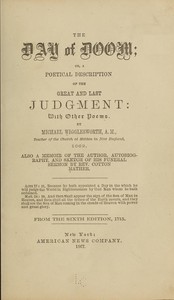
Read on Project GutenbergMichael Wigglesworth’s The Day of Doom (1662) opens not with narrative but with a title page that doubles as a theological thesis, quoting Acts 17:31 and Matthew 24:30. The poem’s structure mirrors a courtroom: Christ as Judge, the elect as assessors, the reprobate as defendants. Wigglesworth’s diction is deliberately plain, even homely—‘stocks that stand at Christ’s left hand’—yet the verse is driven by a relentless ballad meter that propels the reader through 224 stanzas of judgment. The marginalia, mostly Scriptural citations, function as a running footnote, anchoring each doctrinal point to biblical authority.
Wigglesworth chooses common meter (alternating lines of eight and six syllables) for the entire poem, a form familiar from psalms and popular ballads. This metrical choice makes the complex Calvinist theology—election, reprobation, limited atonement—feel immediate and almost singable. The rhyme scheme (aabb) often forces compressed syntax: ‘You never knock’d, yet say God lock’d against you Heaven’s door.’ Such lines trade elegance for mnemonic punch. The regularity of the meter also contrasts with the poem’s terrifying content, creating a tension between form and subject.
Christ’s speeches in the poem are marked by a legalistic, almost prosecutorial tone. He does not merely condemn; he refutes each excuse point by point. To the heathen who plead ignorance of Scripture, the Judge replies: ‘How came your mind to be so blind? I once you knowledge gave.’ The use of second-person ‘you’ throughout creates a sense of direct accusation. Wigglesworth avoids abstract theological language here, instead using concrete verbs: ‘swerv’d,’ ‘deserv’d,’ ‘rejected.’ The Judge’s logic is syllogistic, leaving no room for emotional appeal.
The poem’s margins are filled with Scriptural references—Matthew 11:22, Luke 12:48, John 3:19—that function not as decoration but as proof texts. Each citation corresponds to a specific line of the Judge’s argument, effectively turning the poem into a versified sermon. For instance, when the wicked claim they could not repent, the margin cites John 5:40: ‘But you, vile Race, rejected Grace.’ This interplay between verse and citation suggests Wigglesworth expected readers to check the references, treating the poem as a doctrinal tool rather than mere entertainment.
After the Judge’s final speech, the wicked are described as ‘dismay’d and all amort, / Like stocks that stand at Christ’s left hand and dare no more retort.’ The word ‘stocks’ evokes both wooden blocks and the punishment of being immobilized. Wigglesworth stages the judgment as a series of pleas and rebuttals, but once the Judge has spoken, the reprobate fall silent. This dramatic choice emphasizes the finality of the verdict. The poem then shifts to the torments of hell and the saints’ rejoicing, but the silence of the condemned lingers as the most powerful image.
Readers approaching The Day of Doom should attend to its hybrid nature: part poem, part sermon, part courtroom drama. Wigglesworth’s choices in meter, diction, and marginal apparatus reveal a writer more concerned with doctrinal clarity than literary ornament. The poem rewards those who read the margins as closely as the verses, tracing how each Scriptural citation buttresses the argument. It is a work that demands to be read aloud, its ballad rhythm carrying the weight of seventeenth-century New England theology.
I keep thinking of that old hymnbook’s weight in my lap, those stark lines about judgment, how they made the room quieter than it was. It reminds me of sitting with The Green Helmet and Other Poems — A Closer Reading years later—both felt like hearing someone talk to themselves, unpolished, and somehow that made the words stick closer to my own bones.
Answer a few questions and save a private reflection on this device.









