About 112 minutes
Ancient Ballads and Legends of Hindustan — Context and Discussion
Science Fiction Utopias
25,603 recorded words. 8 minutes difference from this book's estimate.
View Gutenberg source #23245
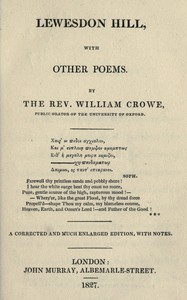
For Lewesdon Hill, with other poems — Themes and Context, the stored edition analysis reports 23,894 words, 1 hr 44 min estimated reading time, and 81 detected text sections.
The text analysis averages about 24.0 words per sentence, while the detected sections provide another way to judge how the source is divided.
Project Gutenberg metadata also associates the work with “English poetry -- 19th century,” connecting these edition facts with the source record’s subject description.
Explore this collection
These alternatives are selected using recorded categories and estimated reading time.
About 112 minutes
Science Fiction Utopias
25,603 recorded words. 8 minutes difference from this book's estimate.
View Gutenberg source #23245About 118 minutes
Science Fiction Utopias
27,017 recorded words. 14 minutes difference from this book's estimate.
View Gutenberg source #75578About 119 minutes
Science Fiction Utopias
27,159 recorded words. 15 minutes difference from this book's estimate.
View Gutenberg source #25480Search stored excerpts and compare books → Choose by your preferences →
Choices use stored catalog measurements. Estimates vary with reading speed. A shared category is a catalog label, not a claim that two books have the same argument or literary quality.
Search reads excerpt text stored with this catalog and links to its associated Gutenberg record. The connection is stored in the site database; this tool does not recheck that every excerpt is word-for-word identical to that external record. Excerpt search does not cover every chapter and does not verify historical publication dates.
Catalog snapshot checked: 2026-09-25. Coverage: 95 public books, 95 available source excerpts.
Read the complete public-domain text at its original source.
Read on Project GutenbergWilliam Crowe's 'Lewesdon Hill' begins with a specific, dated walk: 'To the top of this Hill the Author describes himself as walking on a May morning.' The poem's advertisement acknowledges the risk of being confined to 'mere rural and local description,' but promises excursions into 'something more general and important.' The opening lines, addressed to a 'pure, gentle source of the high, rapturous mood,' immediately establish a voice that is both personal and elevated, invoking Heaven, Earth, and Ocean's Lord. This tension between the particular hill in Dorset and the broader moral landscape shapes the collection.
The volume also includes translations from Lucretius, an elegy for Captain Cook, and verses for university installations. These pieces shift the pace from meditative description to argumentative or commemorative modes, offering a varied reading experience.
The title poem is structured as a single, continuous walk. Crowe uses the physical ascent to organize his reflections: the climb itself becomes a metaphor for rising from local detail to general truth. The advertisement notes that the hill is 'situated in the western part of Dorsetshire,' and that the author was 'led by his residence near the spot.' This grounding in a real place gives the poem a concrete starting point. The voice is that of a solitary walker, addressing the landscape directly: 'Farewell thy printless sands and pebbly shore!' The exclamation marks and invocations create a sense of immediate, personal address, as if the reader is overhearing a conversation with the scene.
The pace is deliberate, matching the act of walking. Crowe does not rush; he pauses to describe, to apostrophize, and to draw moral lessons. The notes appended to the poem, including a quotation from Hutchins's History of Dorsetshire about the hill being a 'sea-mark,' anchor the description in local knowledge. This combination of personal observation and learned reference is characteristic of the poem's method.
The collection includes several translations from Lucretius, which introduce a markedly different voice. The passage beginning 'Suave, mari magno turbantibus' renders Lucretius's famous opening of Book II: 'Sweet is it, when the stormy winds have roused / The boisterous ocean, from on shore to view / The toiling mariner.' Crowe's translation is direct and unadorned, preserving the argumentative structure of the original. The pace here is more rapid, driven by the logical progression of thought: 'not that the pain / Of others gives us pleasure, but for that / To see what ills we ’scape ourselves is sweet.'
Another translation, from Lucretius on the sacrifice of Iphigenia, shifts to a narrative, almost dramatic mode. The lines focus on the victim's perspective: 'when this she saw, / Struck mute with terror, on her knees she sunk.' The language becomes more visceral, with details like 'the dress of sacrifice' and 'ruthless hands.' These translations show Crowe engaging with classical sources not as academic exercises but as living texts that can be adapted to different poetic registers. The contrast with the measured tone of 'Lewesdon Hill' is striking.
The volume includes poems written for specific public occasions: an ode spoken at the installation of Lord North as chancellor of Oxford, and verses intended for the installation of the Duke of Portland. These pieces adopt a formal, celebratory tone, with regular meter and rhyme. The 'Ode to the Lyric Muse' is described as 'Spoken in the Theatre,' indicating a performance context. The voice here is not the solitary walker but the public orator—Crowe was Public Orator of the University of Oxford. The language is elevated and conventional, addressing the muse and praising the chancellor.
The elegy on the death of Captain Cook and the lines written at the tomb of William of Wykeham show Crowe adapting his voice to commemorative purposes. The Wykeham poem uses a simple, hymn-like structure: 'Wykeham, around thy venerable tomb / With fond affection still thy children come.' The pace is slow and reverent. These occasional poems demonstrate Crowe's range, moving from the personal to the public, from the descriptive to the elegiac. They also reveal the social and institutional contexts in which his poetry was produced.
Readers approaching this collection will find a poet who moves between modes with deliberate control. The title poem rewards attention to its local details—the hill, the May morning, the sea-mark—as well as its moral digressions. The translations and occasional pieces offer contrasts in pace and voice, from the argumentative clarity of Lucretius to the formal dignity of university verse. Crowe's own notes, including the advertisement and the historical quotation, provide a frame for understanding his intentions. The volume is best read not as a unified work but as a series of experiments in poetic address, each with its own tempo and register.
I remember climbing a low hill near my grandmother’s house one grey morning, the same quiet ache of place Crowe captures on Lewesdon. That feeling returned, oddly, in Ancient Ballads and Legends of Hindustan — how another land’s names and griefs can feel like your own. Ancient Ballads and Legends of Hindustan — Context and Discussion left me staring out the window, the way this poem did, at no view in particular.
Save your reaction, strongest insight, and memorable passage.









