About 675 minutes
The Oxford Book of Ballads — Themes and Context
Fantasy Juvenile Worlds
155,129 recorded words. 1109 minutes difference from this book's estimate.
View Gutenberg source #44593
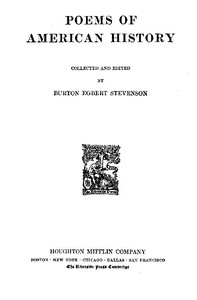
Poems of American History — Themes and Context can be approached with a clearer sense of reading commitment from its source measurements: 410,147 words, 29 hr 44 min estimated reading time, and 81 detected text sections.
The text analysis averages about 20.4 words per sentence, while the detected sections provide another way to judge how the source is divided.
Project Gutenberg metadata also associates the work with “United States -- History -- Poetry,” connecting these edition facts with the source record’s subject description.
Explore this collection
These alternatives are selected using recorded categories and estimated reading time.
About 675 minutes
Fantasy Juvenile Worlds
155,129 recorded words. 1109 minutes difference from this book's estimate.
View Gutenberg source #44593About 540 minutes
Fantasy Juvenile Worlds
124,138 recorded words. 1244 minutes difference from this book's estimate.
View Gutenberg source #27577About 426 minutes
Fantasy Juvenile Worlds
97,970 recorded words. 1358 minutes difference from this book's estimate.
View Gutenberg source #58992Search stored excerpts and compare books → Choose by your preferences →
Choices use stored catalog measurements. Estimates vary with reading speed. A shared category is a catalog label, not a claim that two books have the same argument or literary quality.
Search reads excerpt text stored with this catalog and links to its associated Gutenberg record. The connection is stored in the site database; this tool does not recheck that every excerpt is word-for-word identical to that external record. Excerpt search does not cover every chapter and does not verify historical publication dates.
Catalog snapshot checked: 2026-09-25. Coverage: 95 public books, 95 available source excerpts.
Read the complete public-domain text at its original source.
Read on Project GutenbergBurton Egbert Stevenson’s Poems of American History opens with Samuel Francis Smith’s “America,” a hymn that sets the anthology’s patriotic tone. Yet the collection quickly moves beyond celebration, juxtaposing the familiar “land of the pilgrims’ pride” with scenes of war and loss. The editor organizes 81 sections chronologically, each prefaced by a brief historical note, creating a dialogue between verse and event. This structure invites readers to trace how poets have shaped national memory—from the Revolution through the Mexican-American War, where Whittier’s “The Angels of Buena Vista” depicts Mexican women tending wounded enemies, a moment that complicates simple heroism.
The anthology’s backbone is military history. Sections move from the colonial period through the Civil War and beyond, each anchored by a battle or campaign. Headnotes supply dates, troop numbers, and casualty counts—for instance, the note before Theodore O’Hara’s “The Bivouac of the Dead” reports 264 American dead at a Mexican battle. This factual framing contrasts with the poems’ emotional language, creating a tension between statistical record and poetic lament. Recurring images of “silent tents” and “shivered swords” (O’Hara) unify the sections, suggesting that war’s aftermath is as central as its glory.
Across several poems, women appear as mourners or caregivers. In Whittier’s “The Angels of Buena Vista,” a Mexican woman, Ximena, tends a dying American soldier, calling him “poor boy” and imagining his “gentle, sad-eyed mother” in the North. The poem closes with “white-winged angels” hovering over the battlefield. This maternal figure recurs in other selections, linking domestic tenderness with wartime suffering. The anthology thus uses a repeated character type—the woman who binds wounds or weeps—to humanize conflict, even as the headnotes emphasize strategy and casualties.
Stevenson’s arrangement creates a cinematic quality, shifting from panoramic battle descriptions to intimate deathbed moments. O’Hara’s “The Bivouac of the Dead” moves from “the muffled drum’s sad roll” to a frozen tableau of “plumèd heads bowed.” Whittier’s poem alternates between the “battle down the mountains” and Ximena’s solitary act of giving water. This back-and-forth—between noise and silence, mass and individual—structures the reading experience. The headnotes act as scene breaks, grounding each poem in a specific historical moment while the verses themselves dwell on timeless grief.
Flags appear as recurring motifs, often in moments of transition or loss. In “America,” the “star-spangled” banner is implicit; in battle poems, flags are “trailed in dust” (O’Hara) or “shining on his pistol-belt” (Whittier). These objects serve as emotional anchors, linking the abstract nation to the physical cost of war. The anthology’s structure—moving from Smith’s hopeful anthem to O’Hara’s “martial shroud”—traces a trajectory from symbol to sacrifice, suggesting that national identity is forged in the gap between the two.
Readers may find it useful to read the headnotes first, then the poems, and finally return to the headnotes to measure the distance between factual summary and poetic interpretation. The anthology rewards attention to repeated images—flags, mothers, the dead—that accumulate meaning across sections. Because the excerpts are incomplete, the full collection likely contains further patterns of voice and setting that these observations only begin to suggest.
Some nights, shelving the poems of our national grief—those mothers and flags and quiet dead—I think of how Byron, too, knew the weight of a country’s story carried in a single voice. His verses sit nearby in The Works of Lord Byron, Vol. 7. Poetry — A Reader’s Guide, a different shore, yet the same old ache of remembering.
Build a private reading journal entry for this title.