About 118 minutes
Kentucky Poems — Context and Discussion
Fantasy Juvenile Worlds
27,132 recorded words. 9 minutes difference from this book's estimate.
View Gutenberg source #36661
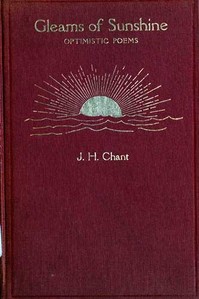
This digital edition of Gleams of Sunshine: Optimistic Poems — Story, Setting & Ideas is described by source-level measurements including 24,874 words, 1 hr 49 min estimated reading time, and 4 detected text sections.
The text analysis averages about 29.3 words per sentence, while the detected sections provide another way to judge how the source is divided.
Project Gutenberg metadata also associates the work with “Christian poetry,” connecting these edition facts with the source record’s subject description.
Explore this collection
These alternatives are selected using recorded categories and estimated reading time.
About 118 minutes
Fantasy Juvenile Worlds
27,132 recorded words. 9 minutes difference from this book's estimate.
View Gutenberg source #36661About 96 minutes
Fantasy Juvenile Worlds
22,051 recorded words. 13 minutes difference from this book's estimate.
View Gutenberg source #34936About 126 minutes
Fantasy Juvenile Worlds
28,856 recorded words. 17 minutes difference from this book's estimate.
View Gutenberg source #60337Search stored excerpts and compare books → Choose by your preferences →
Choices use stored catalog measurements. Estimates vary with reading speed. A shared category is a catalog label, not a claim that two books have the same argument or literary quality.
Search reads excerpt text stored with this catalog and links to its associated Gutenberg record. The connection is stored in the site database; this tool does not recheck that every excerpt is word-for-word identical to that external record. Excerpt search does not cover every chapter and does not verify historical publication dates.
Catalog snapshot checked: 2026-09-25. Coverage: 95 public books, 95 available source excerpts.
Read the complete public-domain text at its original source.
Read on Project GutenbergJoseph Horatio Chant's Gleams of Sunshine: Optimistic Poems (1915) opens with an invocation that frames the entire collection as a divine commission: the poet asks for light to guide his "unskilled hand" and dedicates his powers to God. This self-deprecating posture recurs throughout, as in "The Mosses," where the poet likens himself to humble moss that "cover[s] some scars." The volume's 80-plus poems range from brief nature sketches like "September" to historical pieces such as "Marston Moor" and "The Baptism of Clovis," yet the dominant voice remains that of a Canadian clergyman seeking to reconcile earthly suffering with providential design.
The poet's self-presentation is remarkably consistent. In the invocation, he admits his work "sadly lacks" the Master's touch and may not please "the nice art critic's eye." This humility is not mere convention; it shapes the collection's tone. In "The Mosses," he explicitly asks to be covered over when he dies, hiding "that index of shame"—presumably his name or reputation—while telling the world he "covered some scars." The metaphor of moss hiding geological scars recurs in "The Clouds" and "The Frost on the Window," suggesting a deliberate thematic thread: the poet values concealment and gentle repair over grand display. Even when addressing grand subjects like Niagara's rainbow or the Taj of Agra, Chant's voice remains that of an observer who finds divinity in small, overlooked things.
The collection's pacing varies considerably. Some poems are brief, almost epigrammatic—"A Gem" runs just four lines—while others, like "The Johnstown Disaster," extend to multiple stanzas and adopt a narrative, almost journalistic tone. The historical ballads ("Dunbar," "Marston Moor") move at a brisk, marching rhythm with regular rhyme and meter, while the nature poems ("September," "The Flowers") linger on sensory detail: "The hills are clad in purple and in gold," "The golden-rod still rears its yellow crest." This alternation between rapid historical summary and patient description creates a rhythm that prevents monotony, though the consistently optimistic lens can make even disaster poems feel subdued. Chant's voice remains steady, rarely rising to dramatic heights or sinking into despair.
Despite the title's promise of optimism, Chant repeatedly returns to images of decay, scars, and death—only to reframe them as signs of divine care. In "The Mosses," moss covers "the scars which convulsions have made" and "the rotten and dead." In "September," fallen leaves and fading flowers are balanced by "seed-pods full and ripe" and a "prophecy of more abundant crop." The poem "Hide Their Scars" (listed in the contents) likely extends this motif. Even the grandest theme, as Chant declares, is not nature or history but "the sweet Gospel story" of a Saviour's love. This theological framing allows him to treat loss as temporary and ugliness as surface-level. Readers should note how often the word "scar" or its synonyms appear, and how the poet insists on covering rather than erasing them.
Chant's poems reward attention to small verbal patterns: the repeated plea to be used by God, the fascination with moss and frost, the habit of turning from description to moral application. Readers may find the historical poems less compelling than the nature sketches, but the collection's unity lies in its unwavering voice. Approach these poems not as high art but as a sustained act of pastoral encouragement, written by a man who believed that even an unskilled hand could convey a gleam of sunshine.
I found myself thinking of my grandfather's mossy headstone while reading these poems—how decay and renewal shared the same quiet ground. Something similar stirred in me with Two Fishers, and Other Poems — Reading Companion, where the waiting by still water held the same patient hush. Both books feel like sitting alone, watching sunlight move across old stone.
Your answers remain private and are stored only in this browser.