About 132 minutes
Poems from the Inner Life — A Reader’s Guide
Fantasy Juvenile Worlds
30,340 recorded words. 6 minutes difference from this book's estimate.
View Gutenberg source #56575
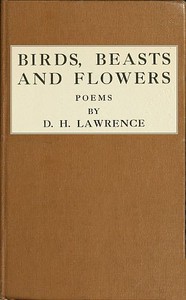
The catalog record for Birds, Beasts and Flowers Poems by D. H. Lawrence — Edition Insights provides practical reading context through 28,856 words, 2 hr 6 min estimated reading time, and 6 detected text sections.
The text analysis averages about 18.9 words per sentence, while the detected sections provide another way to judge how the source is divided.
Project Gutenberg metadata also associates the work with “Animals -- Poetry,” connecting these edition facts with the source record’s subject description.
Explore this collection
These alternatives are selected using recorded categories and estimated reading time.
About 132 minutes
Fantasy Juvenile Worlds
30,340 recorded words. 6 minutes difference from this book's estimate.
View Gutenberg source #56575About 118 minutes
Fantasy Juvenile Worlds
27,132 recorded words. 8 minutes difference from this book's estimate.
View Gutenberg source #36661About 109 minutes
Fantasy Juvenile Worlds
24,874 recorded words. 17 minutes difference from this book's estimate.
View Gutenberg source #24605Search stored excerpts and compare books → Choose by your preferences →
Choices use stored catalog measurements. Estimates vary with reading speed. A shared category is a catalog label, not a claim that two books have the same argument or literary quality.
Search reads excerpt text stored with this catalog and links to its associated Gutenberg record. The connection is stored in the site database; this tool does not recheck that every excerpt is word-for-word identical to that external record. Excerpt search does not cover every chapter and does not verify historical publication dates.
Catalog snapshot checked: 2026-09-25. Coverage: 95 public books, 95 available source excerpts.
Read the complete public-domain text at its original source.
Read on Project GutenbergD. H. Lawrence’s Birds, Beasts and Flowers (1923) opens with a pomegranate that is not merely described but challenged: “You tell me I am wrong. / Who are you, who is anybody to tell me I am wrong?” The poem immediately establishes a combative, intimate voice that refuses to let the reader remain passive. Lawrence moves from Syracuse to Venice to Tuscany, grounding each observation in a specific place—San Gervasio in Tuscany—and in the fruit’s physical details: “crown of spiked green metal / Actually growing!” The fissure in the pomegranate becomes a figure for the poet’s preference for brokenness over wholeness: “For my part, I prefer my heart to be broken.” This opening sets the tone for a collection that treats plants and animals not as symbols but as presences to be argued with, admired, and inhabited.
The first section, “Fruits,” includes poems on pomegranate, peach, medlars and sorb-apples, figs, and grapes. Lawrence does not describe these fruits in static terms; he addresses them, questions them, and uses them to stage philosophical disagreements. In “Peach,” he offers the fruit as a target: “Would you like to throw a stone at me? / Here, take all that’s left of my peach.” The peach is “Blood-red, deep; / Heaven knows how it came to pass. / Somebody’s pound of flesh rendered up.” The language is visceral, almost violent, and the fruit becomes a body, a secret, a wound. Lawrence’s approach is not botanical but confrontational: he treats the fruit as a fellow creature with its own will and history. The poems are set in specific landscapes—Tuscany, Sicily, the Mediterranean—and the speaker’s voice is that of a traveler who has seen these fruits growing and now argues with them from memory.
In “Creatures,” Lawrence turns to animals that are often overlooked or despised: the mosquito, the fish, the bat. The poem “Mosquito” begins with a direct address: “When did you start your tricks, / Monsieur?” The insect is both trivial and menacing, a “little black beast” that the speaker tries to kill. The language is precise about the mosquito’s movements: “You stand on the edge of my bowl of flowers, / And you lift your long black legs.” Lawrence’s attention to physical detail—the legs, the wings, the “needle” of the proboscis—makes the creature vivid and strange. In “Fish,” the speaker imagines the fish’s world: “Fish, oh Fish, / So little matters!” The poem contrasts the fish’s silent, watery existence with human consciousness. Lawrence does not sentimentalize; he observes the fish’s “cold, hard, and compact” body and its “eye that is not an eye.” The creature is alien, and the poem respects that otherness.
The “Reptiles” section includes a remarkable sequence of poems about tortoises: “Baby Tortoise,” “Tortoise Shell,” “Tortoise Family Connections,” “Lui et Elle,” “Tortoise Gallantry,” and “Tortoise Shout.” These poems trace the life of a tortoise from hatching to mating, with a mixture of tenderness and irony. In “Baby Tortoise,” the newborn is described as “a little, little, little, / Almost nothing,” yet it moves with “the slow triumph of his own existence.” The poem emphasizes the tortoise’s isolation: “Isolation is his birthright, / This atom.” In “Lui et Elle,” the male and female tortoises are contrasted: she is “large and matronly,” he is “much smaller” and “almost fiery.” Lawrence observes their mating with a biologist’s eye and a poet’s sympathy, noting the male’s “cruel scar on his shell” and his “grim, reptile determination.” The sequence builds a portrait of a creature that is both comic and heroic.
The later sections include poems on birds and animals from different continents. “Humming-Bird” imagines the bird as a remnant of a prehistoric world: “I can imagine, in some otherworld / Primeval-dumb, far back / In that most awful stillness, that only gasped and hummed, / Humming-birds raced down the avenues.” The poem compresses vast time into a few lines. “Mountain Lion” describes a dead lion encountered in New Mexico: “The long, long beautiful body, the beautiful slender / And massive, heavy, long body.” The speaker’s reaction is one of grief and anger: “And I think, in this empty world there was room for me and a mountain lion.” Lawrence’s animals are always particular, never generic. The settings shift from Europe to the American Southwest, and the poems register the strangeness of each new landscape. The voice remains direct, colloquial, and unafraid of strong feeling.
Lawrence’s poems reward a slow, attentive reading. Notice how he uses line breaks and repetition to mimic the movements of the creatures he describes. The collection is best approached not as a unified argument but as a series of encounters, each with its own tone and setting. The poems are rooted in specific places—Tuscany, Sicily, New Mexico—and the reader may wish to follow the geography as it shifts. Above all, Lawrence asks us to look closely at the non-human world and to resist the urge to make it familiar.
Sometimes Birds, Beasts and Flowers brings me back to that quieter kind of patience, the way Lawrence watches a snake or a fig without forcing meaning. It happens a certain time of year, when the light thins. Then I think of Wilde’s long corridors in the The Ballad of Reading Gaol — Themes and Context, a different sort of watching, though both poems seem to take measure of what solitude does to the spirit.
Build a private reading journal entry for this title.