About 126 minutes
Birds, Beasts and Flowers Poems by D. H. Lawrence — Edition Insights
Fantasy Juvenile Worlds
28,856 recorded words. 6 minutes difference from this book's estimate.
View Gutenberg source #60337
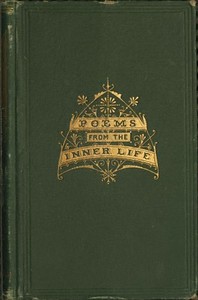
This digital edition of Poems from the Inner Life — A Reader’s Guide is described by source-level measurements including 30,340 words, 2 hr 12 min estimated reading time, and 6 detected text sections.
The text analysis averages about 24.4 words per sentence, while the detected sections provide another way to judge how the source is divided.
Project Gutenberg metadata also associates the work with “American poetry -- 19th century,” connecting these edition facts with the source record’s subject description.
Explore this collection
These alternatives are selected using recorded categories and estimated reading time.
About 126 minutes
Fantasy Juvenile Worlds
28,856 recorded words. 6 minutes difference from this book's estimate.
View Gutenberg source #60337About 118 minutes
Fantasy Juvenile Worlds
27,132 recorded words. 14 minutes difference from this book's estimate.
View Gutenberg source #36661About 109 minutes
Fantasy Juvenile Worlds
24,874 recorded words. 23 minutes difference from this book's estimate.
View Gutenberg source #24605Search stored excerpts and compare books → Choose by your preferences →
Choices use stored catalog measurements. Estimates vary with reading speed. A shared category is a catalog label, not a claim that two books have the same argument or literary quality.
Search reads excerpt text stored with this catalog and links to its associated Gutenberg record. The connection is stored in the site database; this tool does not recheck that every excerpt is word-for-word identical to that external record. Excerpt search does not cover every chapter and does not verify historical publication dates.
Catalog snapshot checked: 2026-09-25. Coverage: 95 public books, 95 available source excerpts.
Read the complete public-domain text at its original source.
Read on Project GutenbergLizzie Doten's Poems from the Inner Life (1863) presents itself as a work of inspired utterance, with the author claiming guidance from invisible intelligences. The collection is divided into two parts, the first containing poems attributed to Doten's own spirit, the second featuring pieces dictated by the spirits of deceased poets such as Robert Burns and Edgar Allan Poe. The prefatory 'Word to the World' establishes a framework of spiritual communion, describing the inner life as a realm where souls may hold converse with the departed. Doten's verse frequently employs imagery of light breaking through shadow, of voyages and embarkations, and of transformation through love or suffering.
The book's organization reflects its spiritualist premise. Part I opens with 'The Prayer of the Sorrowing' and proceeds through poems on truth, embarkation, and love, before closing with 'Birdie's Spirit-Song.' Part II is explicitly attributed to specific spirits: 'My Spirit-Home' and 'I Still Live' are credited to A. W. Sprague; 'For A' That' and 'Words O' Cheer' to Burns; and a sequence of poems—'Resurrexi,' 'The Prophecy of Vala,' 'The Kingdom,' 'The Cradle or Coffin,' 'The Streets of Baltimore,' and 'Farewell to Earth'—to Poe. This division creates a layered authorship: Doten as medium, the spirits as originators, and the reader as witness to a dialogue across the veil. The poems themselves often employ dramatic monologue or direct address, as in 'The Prayer of the Sorrowing,' where a speaker pleads for relief from grief.
Across the excerpts, a consistent visual vocabulary emerges. Light appears as a source of truth and comfort: in 'The Song of Truth,' truth is described as a 'light' that 'shineth in the darkness.' Shadow, by contrast, signifies doubt, sorrow, or the earthly condition. The epigraph from Poe—'And my soul from out that shadow / Hath been lifted evermore'—sets the tone for a collection preoccupied with emergence from darkness. In 'The Embarkation,' the speaker prepares to 'launch away' from the 'shore of time' into a 'boundless sea,' a journey from known shadow into unknown light. The image of the 'cradle or coffin' in Poe's attributed poem suggests the thin boundary between beginnings and endings, a theme reinforced by the title 'Resurrexi' ('I have risen').
The poems frequently enact a movement from one state to another: from sorrow to hope, from earth to heaven, from ignorance to wisdom. 'The Prayer of the Sorrowing' moves from lament to a plea for 'peace'; 'Compensation' promises future recompense for present pain. This structural pattern is mirrored in the shifts between attributed voices. The Burns-inspired poems adopt Scots dialect and a tone of earthy resilience—'For A' That' insists that 'the Lord is guid for a' that' and even 'the de'il himsel' can turn and mend.' The Poe-inspired poems, by contrast, employ a more elevated, sometimes gothic register. The result is a collection that moves not only thematically but also stylistically, as Doten modulates her verse to match the supposed spirit author.
The long poem 'Love' (in Part I) offers the most sustained treatment of a central theme. Love is described as 'the highest attribute of Deity' and a force that 'purgeth passion from the soul and sense.' The poem employs a series of metaphors: love is a 'crucible' that mingles elements, a 'chain' binding humanity to the 'mighty heart of all,' and a power that 'extracts the sweetnesses of Life' from the 'same dull earth' that yields roses and lilies. The speaker contrasts true love with the world's 'gross perversions' and calls for humanity to be 'set face to face with perfect Love.' This idealistic vision aligns with the spiritualist framework: love is the mechanism by which the soul is refined and prepared for higher spheres. The poem's closing lines promise that 'Love's labor never can be lost.'
Readers approaching Poems from the Inner Life will find a work that asks to be read on its own terms: as a record of spiritual experience rather than a conventional literary artifact. The poems reward attention to their recurring imagery and structural patterns—the movement from shadow to light, the interplay of attributed voices, the insistence on love as a transformative force. Doten's preface invites the reader to consider the possibility of communion with the unseen, and the poems themselves enact that communion in form and content.
I keep thinking about that 1863 collection, how its poems drift between grief and comfort like light through a window. It reminded me of the old ballads I once found in The Oxford Book of Ballads — Themes and Context—those anonymous voices also spoke from somewhere beyond, carrying sorrow and hope in the same breath. Strange how certain words linger.
Save your reaction, strongest insight, and memorable passage.