About 46 minutes
The Forerunner, His Parables and Poems — Text and Context
Fantasy Juvenile Worlds
10,373 recorded words. 4 minutes difference from this book's estimate.
View Gutenberg source #54580
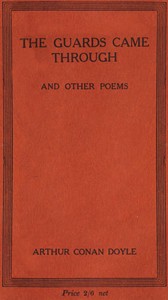
This digital edition of The Guards Came Through, and Other Poems — A Closer Reading is described by source-level measurements including 9,660 words, 42 min estimated reading time, and 2 detected text sections.
The text analysis averages about 21.1 words per sentence, while the detected sections provide another way to judge how the source is divided.
Project Gutenberg metadata also associates the work with “World War, 1914-1918 -- Poetry,” connecting these edition facts with the source record’s subject description.
Explore this collection
These alternatives are selected using recorded categories and estimated reading time.
About 46 minutes
Fantasy Juvenile Worlds
10,373 recorded words. 4 minutes difference from this book's estimate.
View Gutenberg source #54580About 48 minutes
Fantasy Juvenile Worlds
10,942 recorded words. 6 minutes difference from this book's estimate.
View Gutenberg source #55031About 48 minutes
Fantasy Juvenile Worlds
11,025 recorded words. 6 minutes difference from this book's estimate.
View Gutenberg source #66362Search stored excerpts and compare books → Choose by your preferences →
Choices use stored catalog measurements. Estimates vary with reading speed. A shared category is a catalog label, not a claim that two books have the same argument or literary quality.
Search reads excerpt text stored with this catalog and links to its associated Gutenberg record. The connection is stored in the site database; this tool does not recheck that every excerpt is word-for-word identical to that external record. Excerpt search does not cover every chapter and does not verify historical publication dates.
Catalog snapshot checked: 2026-09-25. Coverage: 95 public books, 95 available source excerpts.
Read the complete public-domain text at its original source.
Read on Project GutenbergArthur Conan Doyle's The Guards Came Through, and Other Poems (1919) opens with a title poem that plunges the reader into the voice of a soldier from the Twenty-first—'Men of the Twenty-first, / Up by the Chalk Pit Wood'—whose exhausted, first-person account of being 'beaten and broke in the fight' is punctuated by the repeated refrain 'sticking it, sticking it yet.' The poem's diction is deliberately plain and physical: 'Weak from our wounds and our thirst, / Wanting our sleep and our food.' The arrival of the Guards—'Irish, Welsh and Scot, / Coldstream and Grenadier'—is rendered as a moment of near-relief, with the speaker noting 'We, we were down on our knees, / Praying for us and for them.'
The title poem builds its effect through a narrow, repetitive lexicon. Words like 'sticking,' 'always,' and 'never' recur to create a sense of unrelenting pressure: 'Always the thud and the whine, / Always the yell of the Hun.' The speaker's physical state is given in short, blunt phrases—'Fainting and spent and done'—and the only variation comes with the shouted command 'Stand to!' and the cry 'Clear the front for the Guards!' The relief is understated: the men are 'Praying with tea' in the next line, a deliberately mundane detail that contrasts with the preceding 'tortures of Hell.' Doyle avoids heroic rhetoric; the Guards simply 'came through,' and the poem ends on that flat, factual note.
In 'The Bigot,' Doyle shifts to a sharply different register: the voice of a rationalist attacking religious hypocrisy. The poem uses rhetorical questions and ironic juxtaposition—'What Pagan ever dreamed a sight / So holy and sublime as this!'—to mock the idea of a God who condemns sinners to eternal torment. The diction is deliberately anachronistic and colloquial: 'Poor foolish folk! Had they begun / To weigh the myths that they professed.' Doyle lists biblical miracles ('Balaam's ass, or Samson's might, / Or prophet Jonah and his whale') alongside classical myths ('Theseus or of Hercules') to argue that both are equally implausible. The poem's final stanza turns to direct address: 'O Bigotry, you crowning sin!'—a shift from argument to exclamation that reveals the author's own moral stance.
'The Athabasca Trail' adopts a lyrical, almost ballad-like voice, with a regular meter and refrain: 'With the packer and the packhorse on the Athabasca Trail.' The speaker's nostalgia is built through sensory details—'the roar of rivers where the rapids foam and tear,' 'the balsam-laden air'—and a catalog of Canadian geography: 'the gorge of Erie,' 'the Inland Ocean,' 'the little prairie hamlets.' The poem's structure moves from personal memory ('My life is gliding downwards') to a broader celebration of Canada as 'Mother of a mighty manhood, land of glamour and of hope.' The repeated refrain anchors the poem in a specific, physical journey, contrasting with the static horror of the war poems.
'Ragtime!' takes its cue from a newspaper report that the Titanic's band played ragtime until the end. Doyle transforms this anecdote into a command: 'Ragtime! Ragtime! Keep it going still! / Let them hear the ragtime! Play it with a will!' The poem's short, imperative lines mimic the rhythm of the music—'Now the “Darkey Dandy,” now “The Yellow Coon!”'—while the setting is stark: 'There's glowing hell beneath us where the shattered boilers roar.' The band's persistence is framed as a kind of stoic duty: 'There's nothing more that you can do, and nothing you can mend, / Only keep the ragtime playing to the end.' The poem ends with a shift to a hymn, but the emphasis remains on the act of playing itself.
Doyle's collection moves between the immediate, colloquial voice of the trenches and more formal, meditative or satirical modes. Readers may note how the same poet who wrote the Sherlock Holmes stories applies a similar eye for concrete detail—the 'tea' after battle, the 'packer and packhorse'—to verse that often resists easy patriotism. The poems reward attention to their shifts in register and their use of repetition, refrain, and direct address.
That rainy afternoon, Doyle’s Athabasca lines lingered—long walks, pine-scented air. The war poems felt heavier, though, and I found myself turning pages slowly, almost reluctantly. Later, rummaging for a bookmark, I stumbled onto Trench Ballads, and Other Verses — Reading Companion. Its quieter mud-and-rain cadences seemed to answer something the Guards’ roar left unfinished, the way an echo belongs to the thunder.
Use these questions to collect your thoughts before moving on.