About 48 minutes
Gloucestershire Friends: Poems From a German Prison Camp — Inside the Classic
Fantasy Juvenile Worlds
11,025 recorded words. 0 minutes difference from this book's estimate.
View Gutenberg source #66362
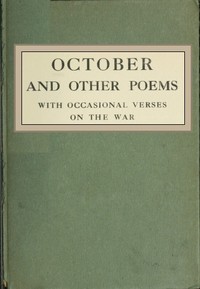
This digital edition of October, and Other Poems; with Occasional Verses on the War — A Reader’s Guide is described by source-level measurements including 10,942 words, 48 min estimated reading time, and 3 detected text sections.
The text analysis averages about 26.1 words per sentence, while the detected sections provide another way to judge how the source is divided.
Project Gutenberg metadata also associates the work with “World War, 1914-1918 -- Poetry,” connecting these edition facts with the source record’s subject description.
Explore this collection
These alternatives are selected using recorded categories and estimated reading time.
About 48 minutes
Fantasy Juvenile Worlds
11,025 recorded words. 0 minutes difference from this book's estimate.
View Gutenberg source #66362About 50 minutes
Fantasy Juvenile Worlds
11,329 recorded words. 2 minutes difference from this book's estimate.
View Gutenberg source #301About 46 minutes
Fantasy Juvenile Worlds
10,373 recorded words. 2 minutes difference from this book's estimate.
View Gutenberg source #54580Search stored excerpts and compare books → Choose by your preferences →
Choices use stored catalog measurements. Estimates vary with reading speed. A shared category is a catalog label, not a claim that two books have the same argument or literary quality.
Search reads excerpt text stored with this catalog and links to its associated Gutenberg record. The connection is stored in the site database; this tool does not recheck that every excerpt is word-for-word identical to that external record. Excerpt search does not cover every chapter and does not verify historical publication dates.
Catalog snapshot checked: 2026-09-25. Coverage: 95 public books, 95 available source excerpts.
Read the complete public-domain text at its original source.
Read on Project GutenbergThe volume opens with a sequence of twelve poems written in 1913, printed privately the following year. These early pieces, such as 'October' and 'The Flowering Tree,' employ a measured, decorative diction—'April adance in play met with his lover May'—and a formal stanzaic regularity. The natural world is rendered with a painterly precision, as in 'Narcissus' or 'Our Lady,' where the language is unhurried, almost ceremonial. This initial section establishes Bridges as a poet of contemplative, pastoral observation, where rhythm and rhyme serve a tranquil, reflective purpose.
The transition from the 1913 poems to the wartime section is abrupt and instructive. The preface notes that the last of the early poems 'proved to be a “war poem,”' and indeed the eighteen occasional pieces that follow adopt a markedly different register. The voice becomes imperative and collective: 'Wake up, England!' and 'Lord Kitchener' deploy direct address, rhetorical questions, and a simpler, more forceful meter. The diction shifts from 'trancèd thought' to 'Stern in onset or defence, / Terrible in their confidence.' The poet laureate's role—to speak for the nation—reshapes his syntax and imagery. Where the early poems favor intricate subordinate clauses, the war verses often use short, declarative lines and repeated exclamations. This change in pace is not merely thematic but structural: the reader moves from a world of 'blossoming boughs' to one of 'blood and hate, in terror and crime.'
The occasional poems are dated from 1914 to 1918, and their composition across the war years allows the reader to trace shifts in tone. Early pieces like 'Wake up, England!' (1914) are urgent and rallying, with a driving iambic beat. Later poems, such as 'The Excellent Way' (October 1918) and 'England to India' (Christmas 1918), adopt a more meditative, philosophical cadence. 'The Excellent Way' opens with a broad, cosmic perspective—'Man’s mind that hath this earth for home / Hath too its far-spread starry dome'—before narrowing to a lament for 'savage foes of yore.' The rhythm here is slower, more measured, with enjambed lines that invite reflection rather than action. This variation in pace mirrors the war's own trajectory from initial fervor to weary endurance. Bridges also experiments with form: the sonnet sequence 'Britannia Victrix' alternates between quatrains and couplets, creating a staccato effect that mimics the 'long ordeal' it describes.
Certain images recur across both sections, but their treatment changes with the poet's evolving voice. The natural world, celebrated in the early poems for its 'dazzle' and 'wild music,' reappears in the war verses as a contrast to human destruction: 'Nature on thy heart would steal / Beckoning thee with heavenly beauty.' The motif of the 'flower' or 'garden' shifts from literal description ('lily and rose') to metaphor for nations and races ('Each race and tribe is as a flower / Set in God’s garden'). Similarly, the concept of 'freedom' or 'liberty' moves from an abstract ideal in the early 'Philosopher and his Mistress' to a concrete, embattled value in 'England to India' and 'Britannia Victrix.' The poet's diction becomes more Latinate and abstract in the later poems—'instincts of omniscience,' 'Immortal modes'—while the early poems favor concrete, sensory language. This lexical shift underscores the movement from personal lyric to public elegy.
Readers approaching this collection should attend to the interplay between its two halves: the private, crafted world of the 1913 poems and the urgent, occasional verses of the war years. The volume's structure—three sections, with the war poems bracketed by earlier and later lyrics—invites comparison across time. Bridges' shifts in diction, rhythm, and address are not merely stylistic but reflect a poet grappling with the demands of his public role. The notes at the end provide contextual clues, but the poems themselves reward close attention to their evolving voice.
That October, I kept returning to Bridges’ wartime verses, the private calm cracking into public ache. Rain blurred the window, and somehow I recalled old ballads’ sorrow, their plain voices carrying grief without fuss. I found my mother’s copy downstairs. The Oxford Book of Ballads — Themes and Context sat beside it, dog-eared at “The Wife of Usher’s Well.” Same rain, I thought. Same ghosts.
Your answers remain private and are stored only in this browser.