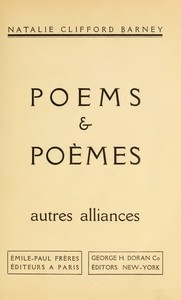
The volume opens with an apology that positions poetry as a necessary, if vulnerable, expression amid war: “While blue and khaki share the heroes mud, / And women tend in white or weep in grey,” the speaker insists that “some must wear the colours of their hearts.” This defense of lyricism against utilitarian scorn sets a defiant tone. The collection then moves through a series of English poems that often address love in paradoxical terms—Judas as the truest disciple, Venus as a weeping, crucified figure. The voice is intimate, sometimes bitter, and frequently turns on images of division: “A double heart and a promiscuous soul.”
War as Backdrop, Not Subject
The opening poem, “Apology,” acknowledges the Great War directly—khaki, grey, wounded bodies—but refuses to let it dominate. Instead, the poet claims the right to “sing, and sometimes write their singing down,” comparing herself to a hurdy-gurdy man whose tune may be ignored. This stance recurs: in “The Weeping Venus,” the goddess’s body “expiates the sin / That love and life with her begin,” a suffering parallel to Christ’s but stripped of explicit war imagery. The conflict remains a distant pressure, not the poem’s engine. Readers should note how Barney uses war as a foil for personal grief rather than as a subject to be documented.
The Divided Self in Love
Several poems explore a fractured identity in relation to a beloved. “The Love of Judas” reframes betrayal as the deepest love: “He loved the most; those others loved but well.” The speaker in “Double Being” (title alone suggests duality) and “More Night!” describes a self “hammocked in unrest,” a “moving shadow, faithless as a lover.” The French section continues this theme: in “Différences,” the speaker declares “Je ne vis que de vous” while contrasting her stillness with the beloved’s restless travel. The recurring motif of doubleness—heart and soul, waking and dream, English and French—invites the reader to trace how identity is split across languages and emotional states.
Sensuous Detail and Ritual
Barney’s poems often anchor emotion in precise sensory objects. In “Réveillon,” a New Year’s Eve scene is built from “turquoise enclose,” “dix chandelles,” and “doigts scintillants,” while the beloved’s face appears “au bout d’un chemin de lumières.” “Fêtes” describes lanterns with “joues peintes” and a hunt for glow-worms guided by an invisible flute. These details create a ritualized, almost decorative atmosphere—parties, costumes, moonlight—that contrasts with the raw grief of poems like “More Night!” The reader should attend to how objects (a flute, a lantern, a branch of apple blossoms) carry emotional weight without explicit explanation.
The French Poems as Counterpoint
The second half of the collection shifts to French, and the voice changes. Poems like “L’Aube” use enjambment and fragmentation: “Le sifflement d’un train / Déchirure ... Banlieue ... Aube.” The speaker feels a touch on the shoulder, a heart “hors de son élément,” then subsides into daily rhythm. “Bal Paré” invites guests to a masked ball with a program that is “incertain,” valuing presence over plan. These poems are more elliptical, less argumentative than the English ones. The bilingual structure itself becomes a reading cue: the two languages do not translate each other but offer parallel emotional registers. Readers may compare how similar themes—love, memory, performance—are handled differently in each language.
Because the excerpts include only the first half of the English poems and a selection of French ones, the collection’s full arc remains unclear. However, the available poems suggest a deliberate interplay between languages and moods. Readers may find it useful to read the English and French sections as separate sequences, then return to the opening apology as a key to the whole: the poet’s right to sing, in whatever tongue, against the noise of the world.
There’s something in Barney’s pairing of war-torn imagery with quiet intimacy that reminds me of old evenings spent leafing through Poems & Poèmes, the French and English whispering across the page. Dickens’s verse holds a similar ache for what’s fleeting—small comforts against larger griefs. I find myself returning to both, gently, the way one revisits a familiar room. The Poems and Verses of Charles Dickens — Key Ideas to Explore stays close on such days.