About 202 minutes
Narrative and Lyric Poems (Second Series) for Use in the Lower School — Reading Notes
Historical Psychological Social Fiction
46,298 recorded words. 21 minutes difference from this book's estimate.
View Gutenberg source #48484
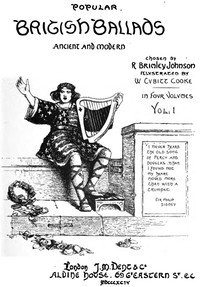
The source record for Popular British Ballads, Ancient and Modern, Vol. 1 (of 4) — A Closer Reading measures this digital text at 41,526 words, 3 hr 1 min estimated reading time, and 13 detected text sections.
The text analysis averages about 21.0 words per sentence, while the detected sections provide another way to judge how the source is divided.
Project Gutenberg metadata also associates the work with “Ballads, English -- England -- Texts,” connecting these edition facts with the source record’s subject description.
Explore this collection
These alternatives are selected using recorded categories and estimated reading time.
About 202 minutes
Historical Psychological Social Fiction
46,298 recorded words. 21 minutes difference from this book's estimate.
View Gutenberg source #48484About 158 minutes
Historical Psychological Social Fiction
36,259 recorded words. 23 minutes difference from this book's estimate.
View Gutenberg source #17948About 217 minutes
Historical Psychological Social Fiction
49,709 recorded words. 36 minutes difference from this book's estimate.
View Gutenberg source #20469Search stored excerpts and compare books → Choose by your preferences →
Choices use stored catalog measurements. Estimates vary with reading speed. A shared category is a catalog label, not a claim that two books have the same argument or literary quality.
Search reads excerpt text stored with this catalog and links to its associated Gutenberg record. The connection is stored in the site database; this tool does not recheck that every excerpt is word-for-word identical to that external record. Excerpt search does not cover every chapter and does not verify historical publication dates.
Catalog snapshot checked: 2026-09-25. Coverage: 95 public books, 95 available source excerpts.
Read the complete public-domain text at its original source.
Read on Project GutenbergThe editor, R. Brimley Johnson, opens with a preface that defines his broad, intuitive approach to selecting ballads: he demands only that a ballad be 'a simple spirited narrative,' and he includes poems in every metre except blank verse. This catholicity sets expectations for a varied collection that prioritizes artistic merit over strict historical or archaeological criteria. The table of contents lists 35 ballads, mixing well-known pieces like 'The Three Ravens' and 'Sir Patrick Spence' with lesser-known works such as 'Leoffricus Glasgerion' and 'The Bonny Lass of Anglesey.'
Johnson's preface is the first guide for a reader. He acknowledges that 'ballad' has a wide significance, from dance songs to simple narratives, and he deliberately avoids rigid definitions. He states that he has been guided 'rather by intuition than by rule' in doubtful cases. This openness suggests that the collection will include both ancient traditionary ballads and modern experiments, as outlined in the four-volume plan. The preface also notes that Volumes I and II contain 'the best traditionary ballads of England and Scotland' plus a small group of peasant ballads still sung in country districts. This framing prepares the reader for a mix of regional dialects, archaic language, and narrative styles.
The excerpt from 'Adam Bel, Clym of the Clough, and William of Cloudesle' exemplifies the spirited narrative Johnson prizes. The ballad moves rapidly through a prison rescue: the three yeomen kill the porter, take his keys, and then shoot the justice and sheriff in the marketplace. The dialogue is direct and functional—'Now are we in,' said Adam Bel, 'Thereof we are full fain'—and the action is punctuated by vivid details like 'They wrang his neck in two' and 'The one hit the justice, the other the sheriff.' The stanza form, with its alternating four-stress and three-stress lines, propels the story forward. Readers should note how the ballad uses repetition and incremental development, a hallmark of the oral tradition.
The text includes marginal glosses for archaic words: 'free, gracious' for 'frank,' 'clown' for 'lordeyne,' 'mad' for 'wode,' 'hood' for 'hode,' 'rushed' for 'stert,' 'wrung' for 'wrong,' 'trusty' for 'sure.' These glosses are essential for a first reading, as the ballad's language can be opaque. For instance, 'stert' and 'wrong' are not immediately recognizable. The editor's decision to include these glosses suggests an audience that may be unfamiliar with Middle English or Scots vocabulary. Readers should use these aids to follow the narrative without getting bogged down. The ballad also contains formulaic phrases like 'merry Carlisle' and 'good yeoman,' which situate it within a folk tradition of stock epithets.
The closing matter of the eBook consists of Project Gutenberg's standard legal and donation information, but it also hints at the collection's broader context. The text mentions that the Foundation 'increases the number of public domain and licensed works that can be freely distributed.' For a reader, this underscores that the ballads are part of a larger effort to preserve cultural heritage. The volume itself, as the first of four, ends without a conclusion; the reader is left to continue with the subsequent volumes. The final excerpt from 'Adam Bel' breaks off mid-stanza, reminding us that this is a digital reproduction of a printed book, with its own material history.
As you read through this volume, pay attention to how the ballads balance narrative drive with lyrical repetition. The editor's preface provides a key to his selections, but the ballads themselves will test your ear for dialect and your patience with archaic forms. Use the glosses and the steady rhythm of the stanzas to guide you. This is not a book to be read quickly, but one to be savoured for its language and its stories of love, betrayal, and heroism.
Reading the preface to the old ballads, I felt that steady pulse of shared stories, the way a familiar tune hums underneath daily life. It reminded me of sitting with Modern British Poetry — Background and Themes, where the same quiet heartbeat seems to persist, though the voices have changed their cadence. Both felt less like collections and more like lingering conversations.
Save your reaction, strongest insight, and memorable passage.









