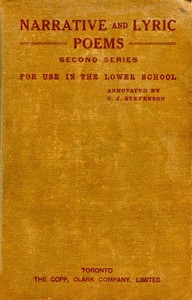
This volume, annotated by O. J. Stevenson for use in Ontario lower schools, presents a prescribed sequence of poems that pairs narrative works like Tennyson's Enoch Arden and Morte D'Arthur with lyric pieces such as Gray's Elegy Written in a Country Churchyard and Shelley's To a Skylark. The annotations focus on explaining points of difficulty, and Stevenson notes where later editions altered words or phrases—for instance, in Enid he follows earlier readings and marks important changes. This editorial attention to textual history gives the collection a scholarly dimension beyond a simple reader's aid.
Diction and the Annotator's Choices
Stevenson's notes target what he calls 'chief points of difficulty,' often clarifying archaic or compressed language. In the excerpt from Tennyson's Ode on the Death of the Duke of Wellington, phrases like 'palter’d with Eternal God for power' or 'turbid streams of rumour' receive explanation, drawing attention to Tennyson's moral vocabulary. The annotator also flags shifts in register—for example, the colloquial 'rugged maxims hewn from life' versus the formal 'sober freedom' and 'temperate kings.' By glossing such choices, Stevenson implicitly trains readers to notice how diction shapes a poem's argument and tone.
Structural Patterns in the Prescribed Poems
The collection's arrangement reveals a deliberate pedagogical structure: narrative poems open the volume, followed by lyrics and odes. Within individual works, Stevenson's notes often highlight formal divisions. In the Ode, the shift from elegiac address to imperative commands ('Remember him who led your hosts') is marked. Similarly, Enoch Arden's opening description—'Long lines of cliff breaking have left a chasm'—uses a natural image to frame the story. The annotator's comments on such structural cues help students see how poets build from setting to theme.
Voice and Moral Address in the Ode
Tennyson's Ode on the Death of the Duke of Wellington employs a public, oratorical voice that Stevenson's notes elucidate. The repeated 'we' and 'our' ('we have a voice,' 'keep it ours') creates a collective speaker, while direct addresses to 'Statesmen' and 'O God' shift the tone. Stevenson points out the moral maxims—'The path of duty was the way to glory'—and their repetition, which reinforces the poem's didactic purpose. The annotator's focus on these rhetorical strategies reveals how Tennyson balances personal grief with national exhortation.
Textual Variants and Editorial Transparency
Stevenson explicitly notes where he follows earlier editions of Tennyson's poems because later versions remain under copyright. For Enid, he indicates 'important changes' in the notes, giving readers access to textual history. This practice is unusual in a school edition and suggests a respect for philological accuracy. The preface also states that poems are arranged 'in the order in which they are named in the prescribed list,' making the volume a transparent tool for exam preparation rather than a literary anthology. Such editorial decisions shape how students encounter the texts.
Stevenson's edition offers a window into early twentieth-century Canadian education, where poetry was studied for both moral uplift and linguistic precision. Readers today may find value in the annotations' attention to textual detail and the way they foreground authorial choices in diction and structure. The volume stands as a record of how these poems were taught, not as a critical interpretation, but as a practical guide to comprehension and memorization.
I remember the schoolroom copies, margins thumbed and penciled with notes on rhyme and meter, and how they made young readers feel the weight of exile in Enoch Arden. Years later, I found the same loneness, the same sung ache of waiting, in the old broadsides of [[American War Ballads and Lyrics, Volume 1 (of 2) A Collection of the Songs and Ballads of the Colonial Wars, the Revolutions, the War of 1812-15, the War with Mexico — Story, Setting & Ideas]], those quiet companions in a shared language of parting.