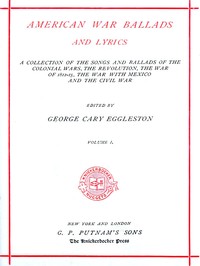
The editor's preface and introduction, though not excerpted, set a scholarly tone for this 1889 collection of American war ballads. The table of contents reveals a chronological sweep from colonial conflicts through the Civil War, with each section introduced by a brief headnote. The first excerpt, from the War of 1812 section, is a ballad celebrating the USS United States victory over HMS Macedonian. Its refrain—'Her motto is "Glory! we conquer or we die"'—immediately establishes the patriotic, boastful voice common to many of these songs.
The Editor's Hand in the Headnotes
Eggleston does not simply present the ballads; he frames them with editorial commentary. In the headnote to 'Perry's Victory,' he calls the ballad 'clumsy as it is in construction' yet notes it 'was very popular in its day, mainly, perhaps, because of the peculiarly dramatic character of the action.' This dual perspective—acknowledging literary flaws while explaining historical appeal—recurs throughout the volume. Readers should watch for these brief judgments, as they signal which poems Eggleston considered historically significant versus artistically successful. The headnotes often provide context about the battle or the song's origin, making them essential for understanding the editor's curatorial choices.
Repetition as a Structural Device
The ballad form relies heavily on repetition, and the excerpts showcase this clearly. In 'The United States and Macedonian,' a four-line refrain appears after every stanza, hammering home the ship's motto and the crew's defiance. Similarly, 'Perry's Victory' uses repeated calls to action—'Now give them your shot, boys'—and exclamations like 'Huzzah!' to build momentum. This repetitive structure served a practical purpose: these songs were meant to be sung or recited aloud, often in group settings. The refrains would have been easy to remember and join in on. For a modern reader, noticing how each ballad handles repetition reveals its intended performance context.
Naval Warfare as a Dominant Theme
The excerpts from the War of 1812 section focus overwhelmingly on naval engagements: the United States vs. Macedonian, Perry's victory on Lake Erie, and the implied exploits of Hull, Decatur, and Jones. The language is full of nautical terms—'mizzen,' 'topmasts,' 'trident,' 'Neptune'—and the ballads celebrate individual ships and commanders. This emphasis reflects the historical importance of the U.S. Navy in the War of 1812, but it also suggests Eggleston's selection bias. The Mexican War and Civil War sections, by contrast, shift to land battles like Monterey and Bethel. Readers moving through the volume will notice this thematic shift from sea to shore, which mirrors the changing nature of American warfare.
The Civil War Section: A Change in Tone
Although the Civil War excerpts are limited, the table of contents lists poems with markedly different titles: 'Brother Jonathan's Lament for Sister Caroline,' 'The Bonnie Blue Flag,' 'Dixie.' These suggest a shift from the triumphalist naval ballads to more elegiac or sectional pieces. The inclusion of Confederate songs like 'The Bonnie Blue Flag' and 'Dixie' indicates Eggleston's attempt at balance, though the volume was published in 1889, well after the war. Readers should compare the emotional register of these later poems with the earlier ones. The naval ballads are almost uniformly confident and aggressive; the Civil War titles hint at loss, lament, and regional identity. This contrast may be the most striking feature of the anthology's arc.
Because this volume spans multiple wars and poetic styles, a first-time reader may benefit from sampling one section at a time rather than reading straight through. Pay attention to the headnotes: Eggleston often reveals why a particular ballad was popular or historically notable, even if its literary merit is slight. The ballads themselves are best read aloud to appreciate their rhythm and refrains. Finally, note that this is only Volume 1; the collection continues in a second volume, which may contain later Civil War songs and perhaps Reconstruction-era material.
Flipping through those old war ballads, I kept noticing how quietly the editor’s hand shaped each turn, the way a harbor shapes a tide. It reminded me of reading Impertinent Poems — that same feeling of someone arranging verses not to march, but to wander. Impertinent Poems — Themes and Context left me with a similar ache for what’s left unsaid between the stanzas.