About 192 minutes
Keats: Poems Published in 1820 — A Reader’s Guide
Adventure Picaresque Fiction
44,133 recorded words. 1 minutes difference from this book's estimate.
View Gutenberg source #23684
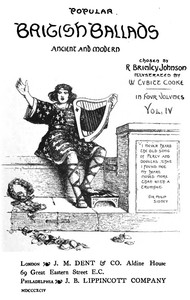
Before opening Popular British Ballads, Ancient and Modern, Vol. 4 (of 4) — A Closer Reading, the edition data offers a quick orientation: 43,759 words, 3 hr 11 min estimated reading time, and 14 detected text sections.
The text analysis averages about 22.6 words per sentence, while the detected sections provide another way to judge how the source is divided.
Project Gutenberg metadata also associates the work with “Ballads, English -- England -- Texts,” connecting these edition facts with the source record’s subject description.
Explore this collection
These alternatives are selected using recorded categories and estimated reading time.
About 192 minutes
Adventure Picaresque Fiction
44,133 recorded words. 1 minutes difference from this book's estimate.
View Gutenberg source #23684About 205 minutes
Adventure Picaresque Fiction
46,941 recorded words. 14 minutes difference from this book's estimate.
View Gutenberg source #41016About 171 minutes
Adventure Picaresque Fiction
39,182 recorded words. 20 minutes difference from this book's estimate.
View Gutenberg source #37074Search stored excerpts and compare books → Choose by your preferences →
Choices use stored catalog measurements. Estimates vary with reading speed. A shared category is a catalog label, not a claim that two books have the same argument or literary quality.
Search reads excerpt text stored with this catalog and links to its associated Gutenberg record. The connection is stored in the site database; this tool does not recheck that every excerpt is word-for-word identical to that external record. Excerpt search does not cover every chapter and does not verify historical publication dates.
Catalog snapshot checked: 2026-09-25. Coverage: 95 public books, 95 available source excerpts.
Read the complete public-domain text at its original source.
Read on Project GutenbergThis fourth volume of Popular British Ballads, Ancient and Modern presents a selection of literary ballads from the 19th and early 20th centuries, chosen by editor R. Brimley Johnson and illustrated by W. Cubitt Cooke. Unlike the earlier volumes in the series, which drew heavily on anonymous traditional ballads, this collection features named poets such as Jean Ingelow, Rudyard Kipling, and A. P. Graves, who adapt the ballad stanza and refrain to tell stories rooted in specific historical events, local legends, or supernatural encounters.
The catalog subjects classify the work under “Ballads, English — England — Texts,” yet the excerpts reveal a broader geographic and thematic range. Poems like “The Battle of the Boyne” and “Shule Agra” engage with Irish history and Jacobite sentiment, while “The Ballad of East and West” by Kipling uses the ballad form to explore colonial encounters. The volume thus complicates a purely English or ancient classification, offering instead a snapshot of how Victorian and Edwardian poets reimagined the ballad for modern audiences.
The excerpts include several poems that use the ballad’s repetitive structure and direct speech to commemorate specific historical events. “The Battle of the Boyne,” adapted by A. P. Graves, narrates the 1690 battle from a Williamite perspective, with lines like “King William threw his bomb-balls in / And set them all on fire.” The poem’s refrain-like repetition of “over the water” reinforces the crossing of the Boyne as a central motif. In contrast, “Shule Agra” voices a Jacobite woman’s lament after the Flight of the Wild Geese: “But when King James was forced to flee, / The Wild Geese spread their wings to sea.” The poem’s refrain “Shule, shule, shule agra!” and its Irish-language glosses signal a cultural identity tied to loss and exile. These ballads do not simply report events but shape political memory through emotional appeal and vernacular detail.
Several ballads in the volume draw on supernatural or Gothic motifs, though the excerpts provide only glimpses. The table of contents lists titles such as “The Witch-Mother,” “The Demon of the Gibbet,” and “The Ballad of the Bier that Conquered,” suggesting a preoccupation with death, haunting, and the macabre. In “The High Tide on the Coast of Lincolnshire,” Jean Ingelow blends natural disaster with domestic tragedy: the speaker recalls her son’s wife Elizabeth, whose song “Cusha! Cusha! Cusha!” is heard before the flood. The poem’s refrain “Play uppe ‘The Brides of Enderby’” ties the rising tide to a local church bell tradition, grounding the supernatural in regional folklore. The inclusion of such pieces alongside historical ballads indicates that the editor valued the ballad’s capacity to evoke both the uncanny and the everyday.
The volume’s ballads frequently employ dialect or regional speech to establish setting and character. In “The High Tide,” the milking song “Cusha! Cusha!” mimics the call to cows, while the narrator’s archaic diction (“myne ears,” “doth still abide”) creates a deliberately antique tone. The Irish ballads go further, incorporating Gaelic phrases with translations: “Go-thee-thu, mavourneen slaun!” (Farewell, my darling) and “Shule, shule, shule agra!” (Come, come, my love). These linguistic markers serve both authenticity and exoticism, appealing to readers interested in regional cultures. The editor’s choice to include such poems alongside standard English ballads suggests a deliberate effort to represent the diversity of British and Irish ballad traditions, even as the volume’s title emphasizes “British” identity.
Readers approaching this volume should be aware that it represents a curated selection of literary ballads rather than a comprehensive anthology of traditional oral verse. The editor’s choices reflect late-Victorian tastes for historical romance, regional color, and the supernatural. The illustrations by W. Cubitt Cooke, though not reproduced in this digital edition, originally accompanied the text and may be consulted in the print source. For those interested in the evolution of the ballad form, comparing these literary examples with the earlier volumes in the series would be instructive.
Sometimes, leafing through these old literary ballads—Kipling’s sea-ghosts, Ingelow’s quiet sorrows—I feel the same ache I find in A Celtic Psaltery Being Mainly Renderings in English Verse from Irish & Welsh Poetry — Themes and Context. Both whisper of a place where the land remembers its dead. They sit well together on the shelf, sharing that longing.
Answer a few questions and save a private reflection on this device.









