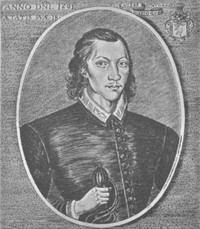
This edition of John Donne's poems, prepared by Herbert J. C. Grierson, foregrounds the textual instability that has long characterized Donne's verse. Rather than presenting a single authoritative text, Grierson's apparatus—drawn from early editions and numerous manuscripts—exposes the fluid boundaries between variant readings. The line notes, which record differences in punctuation, spelling, and word choice across sources such as the 1611 quarto and later folios, transform each poem into a site of editorial negotiation. Readers encounter not a fixed work but a constellation of possibilities, particularly in the 'Anniversary' poems, where the apparatus reveals how small changes can alter rhythm and meaning.
The Apparatus as a Window into Donne's Craft
Grierson's textual notes do more than correct errors; they expose the compositional choices embedded in Donne's verse. For instance, in 'The first Anniversary,' the line 'Yet what wee give to thee, thou gav'st to us' appears in the 1611 edition with a comma after 'thee,' while later editions omit it. Such punctuation shifts affect the line's syntactic flow and emphasis. Similarly, the variant 'Whiles this Muse lives' (1611) versus 'While this Muse lives' (1639) alters the temporal weight of the clause. These details, catalogued without judgment, invite readers to consider how Donne's contemporaries may have heard his lines differently.
Recurring Images of Anatomy and Architecture
The excerpts from the 'Anniversary' poems reveal a persistent interplay between bodily and structural imagery. The world is described as having 'languished' in a 'great earthquake,' its 'vitall spirits' drawn out in a 'common bath of teares.' This anatomical vocabulary—'Anatomie,' 'spirits,' 'soule'—merges with architectural metaphors: the soul climbs to its 'standing house,' and the poem itself is framed as a 'world of wit.' The editor's notes highlight how these images recur across variants, suggesting that Donne's conceits were not merely decorative but central to his argument about mortality and transcendence.
Movement Between Manuscript and Print
Grierson's collation of multiple sources—including manuscripts not previously consulted—reveals the dynamic transmission of Donne's texts. The line 'Sing on thou virgin Soule, whose lossfull gaine' appears with minor spelling variations ('Soule' vs. 'Soul') across editions, but the manuscript tradition may preserve alternative readings not recorded here. The editor's preface notes that earlier modern editions often abandoned the 1633 reading for later variants; this volume restores the primacy of early witnesses while documenting later changes. Readers can trace how a single poem might have evolved through performance, copying, and print.
The Role of the Editor in Shaping Interpretation
Grierson's editorial presence is felt not only in the apparatus but in the structure of the volume itself. The decision to place line notes directly beneath the text—rather than in endnotes—encourages constant cross-referencing. The preface recounts his discovery, while teaching, that existing editions could not explain certain passages; this edition thus emerges from a pedagogical impulse. By foregrounding textual cruces, Grierson implicitly argues that understanding Donne requires engaging with the material history of his poems. The volume becomes a tool for active reading, not passive consumption.
Readers approaching this edition should attend to the line notes as carefully as to the poems themselves. The variants recorded here are not mere curiosities but evidence of a living textual tradition. By comparing readings across editions, one can observe how Donne's language was shaped by scribes, printers, and editors—and how each choice affects the poem's sound and sense. This volume rewards those who read with an eye on the apparatus, treating the page as a palimpsest of possibilities.
I remember evenings spent watching Donne’s punctuation tremble between manuscripts, each version a small, living uncertainty. There is a similar restlessness in Poems 1918-21, Including Three Portraits and Four Cantos — Context and Discussion—not a copying, but a kindred awareness that a line might always be otherwise. Both keep their questions open, like doors left ajar for a breeze.