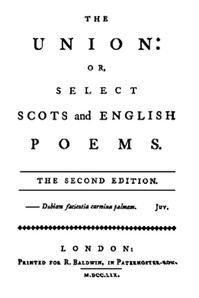
Thomas Warton's preface to The Union (second edition, 1759) immediately establishes the collection's governing principle: a 'judicious' selection of shorter poems by eminent poets, arranged to allow comparison between Scottish and English compositions. Warton contrasts his volume with earlier miscellanies by Dryden and Tonson, which he faults for admitting pieces that 'served to swell the volume,' and praises Dodsley's recent collection while noting that The Union offers a variety 'not to be found' elsewhere—namely, the deliberate intermixture of poems from both nations.
The Preface as Curatorial Statement
Warton's preface is more than a conventional apology; it is a detailed rationale for the anthology's structure. He compares the experience of reading a miscellany to surveying 'a finished landschape, or well disposed piece of shell-work,' where each object is 'singly beautiful' yet gains 'an additional charm' from its arrangement. This metaphor signals that the order of poems matters. Warton also reveals that the collection was made 'under the immediate inspection and conduct of several very ingenious gentlemen,' though he withholds their names—a gesture that both asserts authority and invites curiosity. The preface thus functions as a guide to the reader's expectations: variety, quality, and national comparison are the explicit aims.
Elegy and National Mourning
The excerpted poem 'The Tears of Scotland' (attributed to a 'Gentleman of Scotland') exemplifies the anthology's elegiac strain. Its stanzas mourn the death of Prince Frederick, with the repeated exclamation 'her frederic is no more' punctuating the grief. The poem employs a formal, personified address to 'Arts, Learning, Commerce,' declaring them 'in frederic dead.' Later, a vision of four royal figures—Edward, Arthur, Henry, and Frederick—appears in a 'resplendent gleam,' linking personal loss to national destiny. The language is deliberately archaic ('emprize,' 'obesance'), and the structure follows a conventional elegiac pattern: lament, vision, consolation. This piece illustrates how the anthology uses historical and royal themes to explore collective identity.
Pastoral and Seasonal Contrasts
In contrast to the solemn elegies, the 'ODE ON THE APPROACH OF SUMMER' (by a 'Gentleman formerly of the University of Aberdeen') opens with a Lucretian epigraph celebrating nature's renewal. The poem shifts the collection's tone toward pastoral celebration, invoking classical deities and seasonal imagery. This juxtaposition—elegy followed by ode—is central to Warton's design: the reader moves from death and national crisis to rebirth and natural beauty. The Scottish provenance of both poems (one explicitly, the other by attribution) reinforces the anthology's aim to showcase the range of Scots poetry, from high political lament to Horatian praise of the countryside.
Arrangement as Argument
Because only excerpts are available, the full sequence of poems remains unknown, but the preface's emphasis on 'intermixture' suggests that Warton intended a deliberate alternation of voices and forms. The reader is encouraged to compare the treatment of similar themes—loss, nature, nation—across Scottish and English examples. The anthology's title, The Union, hints at a political as well as poetic joining, though the excerpts do not reveal whether the collection explicitly addresses the 1707 Act of Union. What is clear is that Warton saw the miscellany as a tool for 'forming a comparison and estimate of the taste and genius of the two different nations.' The reader's task is to observe how each poem contributes to that comparative project.
As you read The Union, attend to the order of poems: Warton's arrangement is itself an argument about national character and poetic merit. Notice how elegies and odes, Scots and English pieces, speak to each other across the page. The preface offers a key metaphor—the landscape or shell-work—that rewards attention to placement and contrast. Let the poems themselves, not external summaries, guide your sense of what this 'union' means.
There’s a certain hush in old miscellanies, where elegies sit beside lighter songs, and I kept thinking about that after finishing Warton’s collection. It reminded me of walking a hill alone—not quite solemn, not quite cheerful. That same quiet intermingling lives in Lewesdon Hill, with other poems — Themes and Context, and I’ve found its echoes staying with me long after closing the book.