About 193 minutes
The poems of Edgar Allan Poe — Edition Insights
Fantasy Juvenile Worlds
44,283 recorded words. 5 minutes difference from this book's estimate.
View Gutenberg source #76996
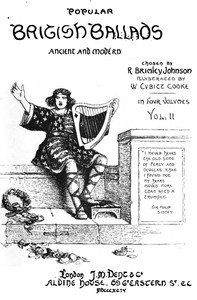
The source record for Popular British Ballads, Ancient and Modern, Vol. 2 (of 4) — Text and Context measures this digital text at 43,050 words, 3 hr 8 min estimated reading time, and 13 detected text sections.
The text analysis averages about 21.3 words per sentence, while the detected sections provide another way to judge how the source is divided.
Project Gutenberg metadata also associates the work with “Ballads, English -- England -- Texts,” connecting these edition facts with the source record’s subject description.
Explore this collection
These alternatives are selected using recorded categories and estimated reading time.
About 193 minutes
Fantasy Juvenile Worlds
44,283 recorded words. 5 minutes difference from this book's estimate.
View Gutenberg source #76996About 198 minutes
Fantasy Juvenile Worlds
45,329 recorded words. 10 minutes difference from this book's estimate.
View Gutenberg source #31172About 132 minutes
Fantasy Juvenile Worlds
30,340 recorded words. 56 minutes difference from this book's estimate.
View Gutenberg source #56575Search stored excerpts and compare books → Choose by your preferences →
Choices use stored catalog measurements. Estimates vary with reading speed. A shared category is a catalog label, not a claim that two books have the same argument or literary quality.
Search reads excerpt text stored with this catalog and links to its associated Gutenberg record. The connection is stored in the site database; this tool does not recheck that every excerpt is word-for-word identical to that external record. Excerpt search does not cover every chapter and does not verify historical publication dates.
Catalog snapshot checked: 2026-09-25. Coverage: 95 public books, 95 available source excerpts.
Read the complete public-domain text at its original source.
Read on Project GutenbergThe second volume of R. Brimley Johnson's anthology opens with 'Thomas the Rhymer', a ballad that immediately establishes the collection's blend of the supernatural and the earthy. Thomas meets a lady 'brisk and bold' whose horse's mane bears 'fifty silver bells and nine'—a detail that signals otherworldly power through precise, countable ornament. The editor's glosses (e.g., 'tett, tuft') appear in parentheses, a practice that recurs throughout the volume and invites readers to attend to dialect without breaking the narrative flow.
Johnson's arrangement groups ballads by theme, moving from supernatural encounters to tragic love, then to comic and domestic tales. The excerpts reveal a consistent pattern: ballads often begin with a chance meeting—on a bank, at a barley field, or aboard a ship—that precipitates a crisis. The language is stark and repetitive, with refrains and incremental repetition that build tension. Readers new to ballad form will find the editor's brief notes helpful for navigating archaic Scots vocabulary.
The opening ballads—'Thomas the Rhymer', 'The Bonny Hind', 'King Henry'—share a structure: a mortal meets a supernatural being, often with a binding condition. In 'Thomas the Rhymer', the Queen of Elfland demands a kiss and seven years' service: 'Sure of your body I will be.' The ballad's forty days and nights of travel through a dark landscape ('He wade thro' red blude to the knee') emphasize the ordeal. The editor's gloss on 'harp and carp' (chat) highlights the verbal play that accompanies the magical bargain.
Later ballads like 'The Dæmon Lover' and 'The Wife of Usher's Well' invert this pattern: the supernatural intrudes into domestic life. In 'The Dæmon Lover', a woman's former lover returns as a demonic figure; in 'The Wife of Usher's Well', three dead sons return as ghosts. The ballads rarely explain the supernatural—it simply is. This matter-of-factness, combined with concrete details (the silver bells, the blood-red wine), creates a world where the uncanny is ordinary.
Many ballads in this volume hinge on a single, fatal choice. In 'Bonny Annie', a woman dies at sea because 'fey folk' are aboard; her lover throws her overboard, yet she swims to Ireland 'as soon as them'. The ballad's compressed narrative—the casting of 'black bullets twice six and forty', the coffin of 'gowd sae yellow'—moves swiftly to its tragic end. The editor's note on 'fey' (doomed) underscores the inevitability.
'Clerk Saunders' and 'Lord Donald' similarly compress courtship and catastrophe into a few stanzas. The ballads use incremental repetition ('He has ta'en her in his arms twa, lo, lift her canny') to slow the action at key moments, then accelerate. Readers should note how the ballads balance dialogue and narration: characters speak in direct, often defiant lines ('That weird shall never daunton me'), while the narrator supplies stark physical details.
'The Laird o' Drum' offers a rare comic interlude. The laird woos a shepherd's daughter, Peggy Coutts, who initially refuses: 'I am not fit to be your bride, / And your whore I'll never be.' The ballad then follows the negotiations with her father, who lists Peggy's practical skills—milking, cheesemaking, mucking out—as her dowry. The laird's retort ('I'll learn your lassie to read and write') inverts expectations.
The wedding feast becomes a scene of social tension: the gentry sneer ('He might hae chosen a higher match'), and the laird's brother complains of 'mickle wrang'. But the laird defends his choice by contrasting his first wife, who was 'far abeen my degree' and would not walk to the gates without pearls, with Peggy, who is welcomed 'in thro' ha's, and in thro' bowers'. The ballad ends with a triple kiss and a firm declaration: 'Ye're welcome, Lady o' Drum.' The editor's glosses on 'lake' (reproach) and 'kebbuck' (cheese) help modern readers grasp the social nuances.
Across the volume, ballads employ formulaic language that signals their oral origins. Phrases like 'Betide me weal, betide me woe' and 'He has ta'en her in his arms twa' recur with slight variations. Refrains—such as 'Lay about, steer about, lay our ship canny'—create a rhythmic anchor. The editor preserves these patterns without modernization, allowing readers to experience the ballads' performance quality.
Johnson's arrangement also highlights thematic echoes: the 'silver bells' of Thomas's lady reappear in 'The Bonny Hind' as a detail of dress; the 'fey folk' of 'Bonny Annie' recall the doomed ships in 'The Dæmon Lover'. Readers may find it rewarding to compare how different ballads treat similar motifs—the kiss that binds, the journey that ends in death, the wedding that crosses class lines. The volume's structure encourages such cross-reading, making it more than a simple anthology.
Johnson's selection and arrangement reward a sequential reading, but the ballads also stand alone. The editor's notes are minimal, leaving readers to infer connections. Pay attention to recurring phrases and objects—the 'milk-white steed', the 'golden glove', the 'bonny may'—as they accumulate meaning across the collection. The ballads' brevity and directness make them ideal for reading aloud; the rhythms and refrains become clearer when spoken. This volume offers a compact survey of the ballad's range, from the supernatural to the domestic, the tragic to the comic.
Those old ballads have a way of staying with you—especially the ones where love makes its own terrible bargain. I found myself thinking of that ache while rereading The poems of Edgar Allan Poe — Edition Insights, how both worlds treat longing like a kind of ghost. Something about the supernatural in each feels less like escape, more like a quiet admission we don’t often say aloud.
Save your reaction, strongest insight, and memorable passage.